Practical guide
Blind Cord Stops vs Loop Hold-Downs: Read the Difference
Distinguish pull cords, inner lift cords and continuous loops. Use five fictional notes to check the stated blind condition, device mismatch and hazards a retrofit leaves unresolved.
On this page
Name the cord before comparing the device
A donut-shaped cord stop and a continuous-loop hold-down address different cord mechanisms. Seeing either device does not establish that a window covering is cordless or that every cord hazard has been eliminated. Begin with the cord arrangement and the exact covering, rather than the generic word “safety.” [1]
CPSC warns that young children can strangle on window-covering cords quickly and silently, even with an adult nearby. It identifies cordless coverings as the safest option where young children are present. This reading guide explains the distinctions in that advice; it does not give a homemade alteration or approve a particular blind.
The existing rented-room guide explains why hiding a cord behind decoration is insufficient. The narrower question here is why a pull-cord stop, an internal cord and a continuous loop cannot be treated as one mechanism. A covering can have more than one relevant cord, so identifying one device does not complete the description.
Three mechanisms have different information checks
CPSC’s page discusses exposed pull cords, inner lift cords and continuous-loop operating cords. Its recommendation concerning cord stops refers to limiting the movement of inner lift cords; its loop recommendation concerns anchoring the continuous loop to the floor or wall. Keep these functions separate when reading a product description.
| Supplied cord description | Source mechanism and device | Completed distinction and limit |
|---|---|---|
| Dangling pull cord | An exposed cord used to raise or lower the blind; the source discusses shortening it as an interim action. | The WCSC retrofit kits described by CPSC do not address the dangling pull-cord hazard of many common blinds. Do not record the covering as cordless. |
| Inner lift cords | Cords involved in raising slats; the source says properly installed and adjusted cord stops limit their movement. | A pull-cord stop addresses this mechanism. It does not establish that every accessible cord hazard has disappeared. |
| Continuous-loop operating cord | A loop used to operate a blind or drapery; the source describes a floor or wall hold-down with suitable fasteners. | A loop hold-down is a different requirement from a donut-shaped pull-cord stop. Its presence alone does not make the covering cordless. |
| Unknown or mixed cord arrangement | The description does not identify the mechanism, covering age or compatible instructions. | Keep those fields unknown. Ask the responsible person or maker for identification; do not choose a device by its name alone. |
On a phone, scroll inside the table to read the conclusion. Keyboard readers can focus its region and use the arrow keys.
These are source descriptions, not a visual identification of your covering. If an actual product has an unfamiliar configuration, retain the model and its instructions and ask the maker or appropriate responsible person. Similar-looking parts, a product listing or a photograph alone do not prove compatibility or a completed installation.
The cord-stop distance has a stated blind condition
For the cord stops it describes, CPSC states a position within 1 to 2 inches from the head rail when the blind is fully lowered. The reference point and blind state belong to that statement. A number without those conditions cannot complete the comparison. [1]
Worksheet WC-1118-D below contains five original fictional notes. A and B supply that fully lowered state and reference point: 0.5 inch is below 1 inch, while B’s 1.5 inches lies within the stated interval. C supplies the same 1.5 inches but describes a partly raised blind, so the required observation is missing. The contrast shows why a number and its condition must be read together. This is a check of supplied information, not a direction to move or test an actual cord.
| Original fictional note | Supplied state or missing information | Completed reading conclusion |
|---|---|---|
| A — pull-cord stop at 0.5 inch | Fictional note explicitly says the blind is fully lowered; distance is from the head rail. | Below the source’s 1–2-inch interval. The note does not satisfy that stated position check; no adjustment or safety approval is performed. |
| B — pull-cord stop at 1.5 inches | Fictional note supplies the same fully lowered state and head-rail reference. | Within the stated interval under the supplied fully lowered condition. This answers only the position comparison; installation and remaining cord hazards are not established. |
| C — pull-cord stop at 1.5 inches | Fictional note says the blind is partly raised; it supplies no fully lowered observation. | The number falls between 1 and 2, but the required blind state is missing. Leave the source-conditioned comparison unresolved. |
| D — continuous loop plus a donut-shaped stop | Fictional note supplies no compatible loop hold-down, fastener or surface information. | Do not substitute the pull-cord stop for the separate loop requirement. The presence and compatibility of a loop hold-down remain unresolved. |
| E — retrofit kit with a dangling pull cord | Fictional note supplies a kit name, but still describes an exposed pull cord beside a young child’s bed. | Do not call the hazard eliminated or the covering cordless. The source warns about the remaining pull cord and furniture access; appropriate resolution is needed. |
Even a complete description within the stated interval would answer only that source-specific position comparison. It would not establish proper installation, identify every cord, eliminate a dangling pull cord or certify a room where a child can reach the window. A numerical match must not become a broader safety conclusion.
A loop hold-down and a retrofit have separate limits
CPSC’s continuous-loop advice calls for anchoring to the floor or wall with appropriate fasteners for the intended surface, leaving the cord taut but operable. A donut-shaped pull-cord stop does not supply those separate requirements. Neither a picture-hook weight rating nor rental permission proves that the covering’s loop device and attachment are suitable. [1]
Use the exact covering and appropriate instructions through the responsible installer or maker. This page does not select fasteners, approve an adhesive substitute or prescribe how to tension or modify a cord. A missing device or unidentified surface should remain an unresolved issue.
The source says its interim actions reduce risk rather than eliminate the hazard. It specifically warns that WCSC retrofit kits do not address the dangling pull-cord hazard associated with many common blinds. A kit therefore cannot be renamed a cordless conversion in a household note merely because it includes a safety part.
CPSC also warns that most blinds sold before November 2000 have inner cords that a child can pull into a loop, and says to replace those types immediately. An unknown sale date or unidentified cord arrangement does not show that this warning is inapplicable. Ask for the actual product information rather than assuming that an older blind has been made safe by an unspecified kit.
Keep child access and rental responsibility visible
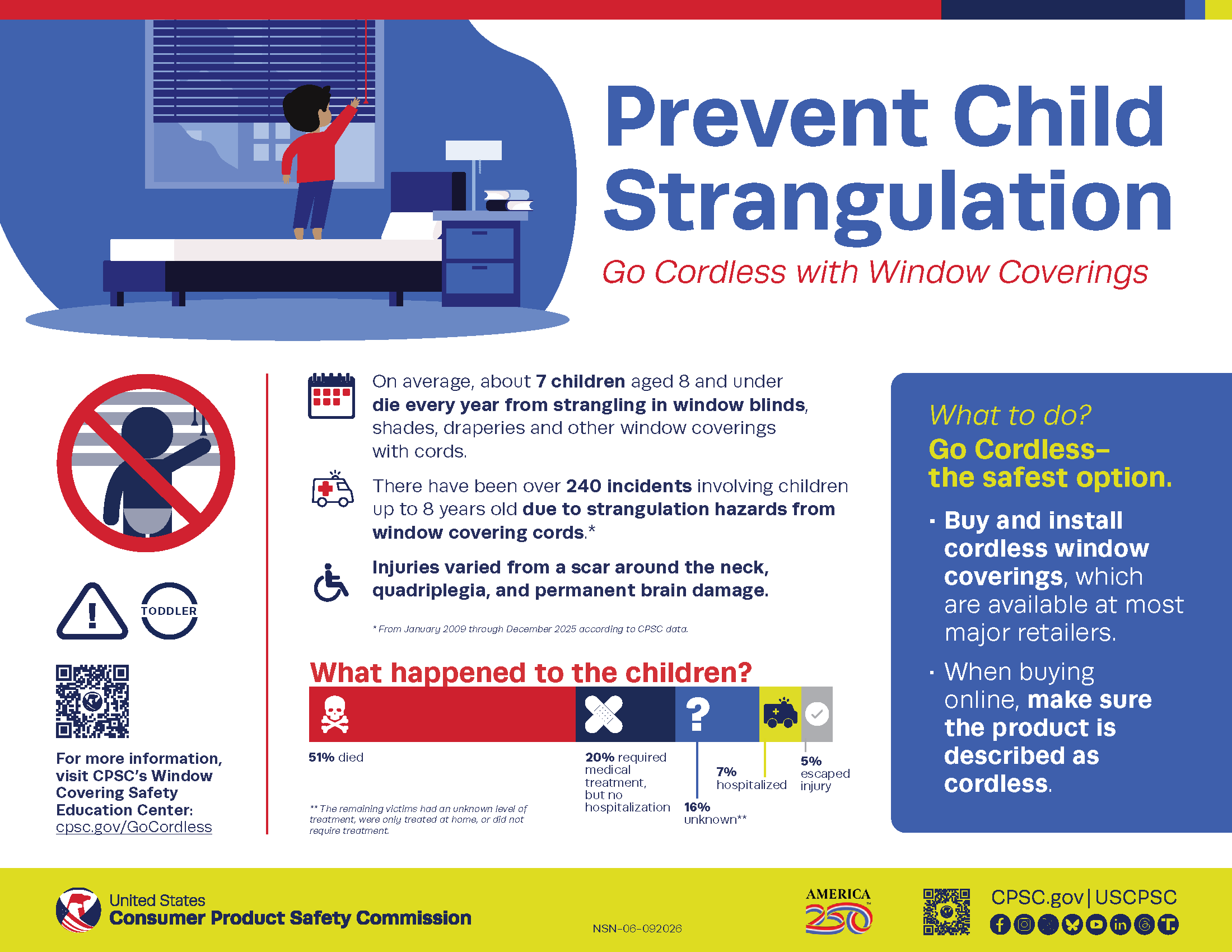
CPSC advises moving cribs, beds, furniture and toys away from windows and cords, preferably to another wall. Its original poster depicts a child reaching toward a blind cord from a bed and encourages buying cordless coverings, including looking for online products described as cordless. The image illustrates access and the replacement message; it does not inspect this worksheet or your home. [2]
A fixed landlord-provided bed or a restriction on fittings does not resolve a cord hazard. Contact the person responsible for the property and the appropriate maker or qualified channel promptly about the covering, child access and a suitable replacement or other required action. Record what has actually been agreed or completed separately from what you requested.
Do not keep an accessible hazard as a decor experiment or hide it behind a plant, fabric or screen. If a young child is present, the source’s cordless recommendation remains central. A fitted curtain rod, a tidy photograph or a general lease permission does not establish a safe window-covering arrangement.
One complete fictional cord-reading record
Samira’s completed record combines the supplied notes without pretending that an actual room has been inspected. Every unresolved state or mechanism remains visible. The values are original teaching inputs and the record is a reading aid, not an installation checklist that certifies safety.
- Reader and invented material
- Samira; wholly fictional Worksheet WC-1118-D. Notes A–E are invented descriptions, not observations of actual blinds or homes.
- Fixed reading question
- Which cord mechanism does each description identify, and which source conditions or unresolved hazards must stay with the conclusion?
- Reference and distinction
- CPSC Window Covering Cords: pull cords, inner lift cords and continuous-loop cords; interim measures reduce rather than eliminate the hazard.
- Conditional position check
- For A and B only, the fictional notes supply a fully lowered blind and head-rail distance. 0.5 is below 1; 1.5 lies within 1–2. B answers only that position comparison.
- Missing state and mechanism
- C lacks the fully lowered observation. D describes a loop but does not establish its compatible hold-down, intended surface or fasteners.
- Residual hazard and access
- E still has a dangling pull cord beside a young child’s bed. A kit name does not erase the described cord or furniture access.
- Responsible next step
- For a real covering, obtain its identity and appropriate guidance from the maker and person responsible for the property; resolve child access and replacement needs promptly. No permission or work is assumed.
- Bounded conclusion
- These supplied descriptions cannot establish completed installation, a hazard-free room or a personal risk probability. No actual child, resident, covering or safety outcome was assessed.
For private real-world notes, name the actual covering, retain the relevant instructions and distinguish a question, a request and completed work. Leave unknown fields unknown. This website does not receive the record or assess a child’s circumstances, and the optional blank form does not calculate a risk score.
Three explained checks on state, mechanism and remaining hazard
Try these original fictional descriptions before opening the complete explanations. Each answer is limited to what the supplied note establishes.
Case 1
Note C puts a pull-cord stop 1.5 inches from the head rail while the blind is partly raised. Can the reader mark the source’s position condition satisfied because 1.5 lies between 1 and 2?
Show answer and explanation for case 1
No. The fully lowered blind condition has not been supplied.
The source’s distance statement includes a reference point and a fully lowered blind. C supplies a different state. Keep that comparison unresolved; a matching number alone neither establishes the stated condition nor approves the covering.
Case 2
Note D describes a continuous-loop cord and a donut-shaped pull-cord stop, but no loop hold-down or compatible attachment information. Does the visible stop complete the loop requirement?
Show answer and explanation for case 2
No. A pull-cord stop does not establish the separate continuous-loop hold-down requirement.
CPSC gives distinct mechanism-specific advice. The note lacks the loop device, intended surface and appropriate fastening information. It cannot establish that the loop is properly restrained, operable or cordless; obtain the actual covering’s guidance through the responsible channel.
Case 3
Note E describes a retrofit kit and an exposed pull cord beside a young child’s bed. May the summary say “cordless and hazard eliminated”?
Show answer and explanation for case 3
No. The described dangling cord and access remain unresolved hazards.
CPSC says interim measures reduce rather than eliminate the hazard, and notes that retrofit kits do not address the dangling pull-cord hazard of many common blinds. The kit name does not erase E’s described cord or bed access. Appropriate resolution and the cordless recommendation remain necessary.
Sources and further reading
- CPSC — Window Covering CordsComplete current extracted main read: three cord mechanisms, source-conditioned cord-stop position, loop attachment requirements and limits of interim measures. No actual installation or complete regulatory audit.
- CPSC — Prevent Child Strangulation original posterComplete original poster viewed. Bed-to-cord access illustration and cordless selection message used; dated incident statistics and QR destinations not adopted. Source image is not republished.