Practical guide
Feng Shui in a Rented Room: Layout Ideas Without Moving Furniture
Record the actual difficulty, safety and permission limits. Try one suitable reversible adjustment, then check daylight, routes, privacy and reset without promising personal outcomes.
Start with the room you can actually use
You can make a rented room easier to use without moving its bed, wardrobe or desk. Begin with one concrete difficulty: a bag blocks the door, afternoon light reflects in your screen, or a work lamp disturbs a roommate. Choose a reversible adjustment to that difficulty, rather than trying to make every furniture position match a diagram.
In this guide, “without moving furniture” means leaving the main furniture and architecture in place. It does not mean a hazardous arrangement must stay. A blocked exit, unsafe fixture or accessible window-covering cord needs appropriate action, even when decoration cannot resolve it. Contact the responsible landlord, building manager or qualified person where the needed change is outside your control.
Feng shui offers several traditional and modern interpretive frameworks. Jan Cisek’s practitioner discussion distinguishes compass-based and entry-aligned bagua methods. They do not establish the same orientation. If you use a map for reflection, name the method; our method comparison explains that difference. You do not need to calculate a bagua grid to clear a route or reduce visible glare.
We use the cultural framework as an optional way to notice a room, not as evidence that a position causes illness, relationship trouble or lost income. The practical questions below concern access, usable light, privacy and maintenance. None of the examples is a measured home inspection or a promise of improved luck, sleep or health.
Write down constraints before choosing a reversible change
A useful plan has a baseline: what is fixed, what permission you have and what happens during normal use. Sketch the door, its swing, windows, fixed furniture, existing light controls and the route to the room’s exit. Mark where the current difficulty occurs. This is a working room sketch, not a surveyed plan or an approved evacuation drawing.
| Constraint | Check in your actual room | Keep this limit visible |
|---|---|---|
| Fixed bed, desk or wardrobe | Leave the main piece in place; identify the specific task it makes difficult. | Small objects and habits may change; a safety obstruction still needs escalation. |
| Lease and finishes | Read actual restrictions on adhesives, hanging items, fixtures and alterations. | “No drill” and “removable” do not establish permission or damage-free removal. |
| Windows, coverings and cords | Check operation and reachable cords before proposing a new textile. | Young-child cord hazards are not cured by hiding a cord behind decor. |
| Doors, routes and shared use | Check the actual door swing and routes people use, with their needs. | A diagram or one universal width does not certify accessibility or escape. |
| Sockets, lamps and controls | Use an existing suitable fixture according to its instructions. | A room guide cannot approve wiring, overloaded connections or fixture modifications. |
| Roommate and maintenance needs | Agree what may change, who controls it and how it will be restored. | A proposed change is not an agreement; privacy includes the other resident. |
Observe from the places you actually occupy: the doorway, the work seat, the bed and the shared route. A layout that looks calm from the entrance might hide the one bag you step around each morning. A screen that improves the doorway view might block a roommate’s light or access. Name the affected person and routine in the record.
Take a private before-note or photograph if useful and permitted. Avoid capturing another resident’s belongings or private information without their agreement. Record what you can see, such as “the lamp reflects in the monitor,” rather than an interpretation such as “this corner has bad energy.” That distinction makes a later decision easier to explain.
Choose one adjustment that changes the observed problem
Start with what you already have. “Reversible” means you know how to restore the arrangement without creating a new problem; it does not mean every adhesive, tension fitting or portable screen is harmless. Check the exact item’s instructions, stability, surroundings and lease restrictions before adding it.
| Observed difficulty | First option to consider | Check after the change | Avoid this shortcut |
|---|---|---|---|
| Bag or shoes interrupt the entry route | Put the loose items in an existing suitable storage space; agree a return habit. | Open the door normally and check the actual route again. | Do not add a basket into the same obstruction. |
| A fixed desk gets afternoon screen glare | Try an existing blind adjustment or a different screen/lamp angle. | Use the actual seat at the affected time; compare reflections and task visibility. | Dimming everything is not automatically a lighting improvement. |
| The work surface is dim but the bed is brightly lit | Adjust an existing task lamp toward the needed surface, as designed. | Read or work normally; check the roommate’s view too. | Do not change wiring or place fabric near a lamp. |
| A view into personal belongings feels intrusive | Close an existing door or use agreed storage boundaries first. | Check what remains visible from the normal shared position. | A tall divider may block light, airflow, doors or routes. |
| A mirror reflects a distracting bright source | Change the source’s angle or close an existing covering if permitted. | Check from the bed and work seat, not only from the doorway. | Do not attach a heavy cover or hang fabric near heat. |
| The desk carries both work and bedtime objects | Use an existing drawer or portable task kit; clear the surface after use. | Can the next routine start without a pile on the bed or floor? | Moving clutter to a walking route is not a solution. |
| A symbolic object adds worry or clutter | Leave it out; keep the useful practical adjustment. | Is the task easier without the object or extra rule? | A charm, crystal or color does not supply safety clearance. |
Choose the row that matches the difficulty you recorded. You are not expected to do all seven. If you cannot identify a problem, keeping the present layout is a valid decision. If the only possible change needs permission, end the plan at “request or clarify” until that permission arrives.
Do not treat a removable rug as a default way to define zones: edges, movement and the people using the route matter. Likewise, under-bed storage is useful only if it remains suitable and accessible in the actual room. A tidier photograph does not establish that the person using an aid, carrying laundry or opening the door has better access.
Check daylight, access and privacy together
The Canadian Centre for Occupational Health and Safety’s lighting overview distinguishes general and task lighting and discusses daylight variation and glare. It concerns workplace ergonomics; here we borrow the basic observation that enough light and controlled glare must be considered together. We have not measured your room or established a residential lighting standard.
| Check | What to do | Useful observation | Boundary |
|---|---|---|---|
| Daylight, at the troublesome time | Use the existing covering as designed; compare the task surface and visible reflections. | The task remains visible and the distracting reflection is reduced. | Daylight changes with time, season and weather; do not call one observation a lux measurement. |
| Lighting, during the actual task | Read, work or find an object from the normal seat with existing controls. | The light reaches the task without an obvious distracting source in view. | No universal lamp brightness, color temperature or medical result is prescribed here. |
| Routes, doors and windows | Check the actual door swing and keep needed exit doors/windows unobstructed. | Loose belongings do not interrupt the route or operation of the needed opening. | Follow building/local guidance; this is not an accessibility or evacuation certification. |
| Privacy, from normal occupied positions | Ask the affected resident; check the view without photographing their private area. | The agreed boundary helps without taking away light, access or needed ventilation. | Do not assume a roommate accepted a screen because it looks better to you. |
| Reset and everyday use | Put things away, retrieve them and return the room to its usual routine. | The new storage or lamp arrangement can be maintained and restored. | A change that merely transfers clutter or work to someone else needs revision. |
A curtain can reduce glare and increase privacy while also reducing the daylight available for work. Record both effects. Try a smaller adjustment to the existing covering or a suitable task-light setting before concluding that a completely darkened room is better. Repeat the observation when the original problem happens, rather than comparing bright midday with a different evening task.
USFA’s home escape-planning guidance says to keep doors and windows from being blocked and plan escape routes. Do not invent a single minimum passage width from that advice. The needed clear space depends on the person, doors, building rules and applicable requirements. In particular, a small distance written on a sketch does not prove wheelchair access or safe evacuation.
Follow the actual building’s fire arrangements and local guidance. This room-use checklist does not decide whether a particular apartment should evacuate or stay put during a fire. Do not alter fire doors or obstruct safety equipment to improve a view. Where furniture itself makes an essential route unusable, a decorative adjustment is insufficient.
Treat window-covering cords as a safety issue, not a decor detail
CPSC’s window-covering guidance warns that cords can strangle young children, quickly and silently, even with an adult nearby. It identifies cordless coverings as the safest option where young children are present. A neat-looking or shortened cord is not the same as a cordless covering.
The agency describes cord retrofits as reducing risk, rather than eliminating it, and advises moving beds, cribs, furniture and toys away from windows and cords. If your rented-room constraint prevents the necessary change, do not use “the bed cannot move” as a reason to accept the hazard. Contact the responsible person to resolve it and follow appropriate safety guidance. A plant, mirror cover, decorative clip or privacy screen does not establish a safe arrangement.
We do not provide a homemade cord modification or approve any fitting. Ask about the actual covering and permitted replacement or adjustment through the appropriate landlord or qualified channel. If the window or covering needs repair, record the issue as maintenance. A room-use trial should not include a hazardous condition to see whether it feels more comfortable.
Stop the proposed adjustment if it interferes with an opening, route, light control, needed airflow or another resident’s use. Unsafe electrical equipment, damaged fixtures and suspected structural problems also need appropriate handling beyond this guide. A reversible household choice can be useful; it cannot replace a safety repair.
Three fictional examples keep the limitation visible
These are original invented situations, not inspected rooms, testimonials or tested outcomes. Their purpose is to show how one observed problem leads to a limited plan and a check.
1. A fixed desk with afternoon glare
Nadia’s rental desk cannot move. She records that a bright reflection appears in her screen in late afternoon. Using the existing blind as designed, she tries a partial adjustment and keeps the work lamp unchanged.
She checks the same task from the same seat when the reflection normally occurs. If the surface becomes too dim, she revises the adjustment rather than accepting darkness as the price of better feng shui.
2. An entry that becomes storage
Owen’s bed and wardrobe stay fixed. His backpack is the loose item interrupting the door route. He uses an existing suitable wardrobe space and agrees a put-away habit instead of buying a floor basket.
He checks the door swing and the actual route again. This illustrates clearing a loose obstruction; it does not certify a passage width or solve an obstruction caused by fixed furniture.
3. A shared room with different evening routines
Leila wants light for reading while her roommate wants less light near the bed. They discuss an existing adjustable task lamp and try its directed angle, leaving the beds in place.
They check both normal positions and agree who resets the lamp. If the light still causes a problem, they revise the plan together; the proposal is not treated as consent or proof of improved sleep.
Each plan can finish with “keep,” “revise,” “undo,” or “request help.” Keeping a useful change does not validate a metaphysical explanation. Undoing one does not mean the resident failed a method: the practical observation simply did not support that option.
Use two short records instead of a makeover checklist
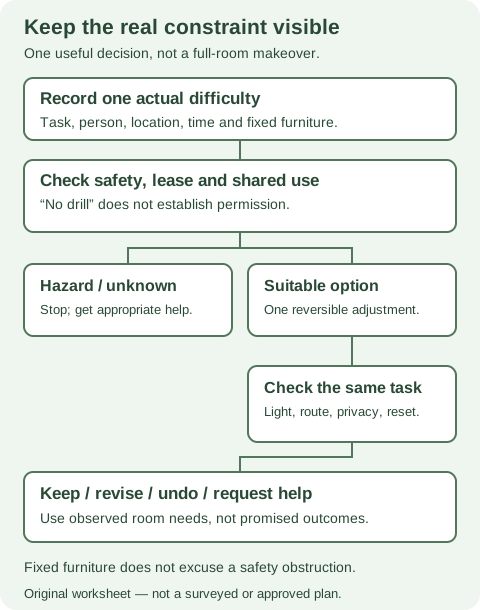
The first record captures constraints and the baseline. The second records what actually changed and whether it helped the original task. A proposed action and a completed action should remain separate.
RENTED ROOM — CONSTRAINT AND BEFORE RECORD
Main furniture/architecture staying fixed:
Actual task and person affected:
Observed difficulty; location and usual time:
Door swing, needed openings and actual route:
Daylight, existing controls and distracting reflections:
Privacy/shared-use concern and the other person's view:
Lease, item instructions, permission or maintenance question:
Safety concern that needs action outside this decor plan:
One proposed reversible change, or no change:
ONE CHANGE — PRACTICAL REVIEW RECORD
Permission/agreement actually obtained, or still pending:
Adjustment actually made; date and task conditions:
How to restore the original arrangement:
Same-task observations: light / route / privacy / reset:
New difficulty for me or another resident:
Keep / revise / undo / request appropriate help:
Reason based on the observation, not a promised outcome:
Unknowns and the next check, if needed:
This is not a surveyed plan, safety approval or causal test.
Download both records, the adjustment menu, fictional examples and answer notes. These are blank worksheets for private use; the page does not submit your room details. You can leave a box unknown when permission, a fitting’s instructions or a building requirement needs clarification.
Compare similar task conditions where practical. A brighter day, different work or a roommate’s absence may explain part of a change. You do not need to run a controlled experiment, assign an energy score or continue an unsuitable arrangement for a fixed week. The record supports a household decision, not proof that feng shui caused a health or life outcome.
Six checks before calling the room plan finished
Try these original cases before opening the answers. They test the scope of a practical plan, not a building’s compliance or anyone’s personal fortune.
Case 1
A landlord-provided bed cannot move, but a loose bag stops the door opening normally. Must the whole room be rearranged?
Show answer and explanation for case 1
Start with the loose obstruction and recheck the actual opening and route.
A suitable existing storage location may address this problem without moving the bed. If fixed furniture still blocks needed access, the decorative plan is insufficient and appropriate help is needed.
Case 2
A privacy screen hides belongings but blocks the window and the shared route. Is it a useful improvement because it is portable?
Show answer and explanation for case 2
No. Revise or undo the screen arrangement.
Portability does not establish safety, permission or better shared use. Check privacy together with light, needed openings, actual routes and the other resident’s needs.
Case 3
A blind cord is tucked behind a plant beside a bed used by a young child. Has the decoration eliminated the cord hazard?
Show answer and explanation for case 3
No. Hiding the cord does not establish a safe arrangement.
CPSC identifies cordless coverings as safest where young children are present and says retrofits only reduce risk. Fixed furniture or rental constraints need an appropriate safety resolution, not concealment.
Case 4
A room sketch shows one fixed passage width. Does that certify accessibility and fire escape for every resident?
Show answer and explanation for case 4
No. A single dimension is not that certification.
Check actual users, opening operation, building/local instructions and applicable requirements. USFA’s clear-route guidance does not supply a universal width for this rented room.
Case 5
The existing blind reduces screen glare but makes the task difficult to see. Should the darker setting stay because the reflection disappeared?
Show answer and explanation for case 5
Reconsider the setting and suitable task lighting together.
Glare control and usable illumination both matter. Observe the same task from the actual seat; this is not a lux measurement or proof that a completely dark room is better.
Case 6
A listing calls an adhesive mirror cover removable. Does that establish lease permission and damage-free removal?
Show answer and explanation for case 6
No. Check actual permission, surface suitability and item instructions first.
A marketing label does not resolve those questions. Keep the plan pending if needed, and consider an existing control or leaving the mirror alone rather than inventing approval.
Sources and further reading
- USFA: Home Fire Escape Plans (reviewed 10 April 2025)USFA general clear doors/windows and escape planning, not a universal passage width or a building-specific evacuation protocol.
- CCOHS: Lighting Ergonomics — General (revised 10 July 2025)CCOHS workplace lighting principles applied cautiously to observing a task; no measured lux, medical result or residential code claim.
- CPSC: Window Covering CordsWindow-covering cord hazards, cordless coverings where young children are present, and why cord retrofits reduce rather than eliminate risk. This source does not approve your room or a homemade modification.
- Jan Cisek: Compass and Western Three-Door Gate Bagua ComparisonPractitioner explanation of compass-based and entry-aligned methods. Used for method distinctions, not as scientific evidence of health, financial or personal effects.