Practice worksheet
Compass vs Entry-Aligned Bagua Maps: Comparing the Methods
A compass-oriented bagua uses actual directions as its reference; an entry-aligned overlay uses the chosen entrance side. The same corner can receive different symbolic labels because the orientation rule changes. Name the method, boundary and reference before comparing diagrams. A simple nine-area key is not a complete analysis of a classical compass school.
Two references: direction and position from the entrance
| Question | Compass-oriented association | Entry-aligned overlay |
|---|---|---|
| What is the reference? | North and the other actual directions, using the stated method. | The chosen entrance side of the outlined space. |
| Where is wealth in the simplified association key? | Southeast. | Back left when standing at the chosen entrance and looking inward. |
| Where is career? | North. | Front center in the entrance-side grid. |
| Must the doorway be north? | No. Direction and the doorway are separate facts. | No. The entrance reference does not rename its actual direction. |
| What else might a teacher use? | School-specific geometry, facing, time or personal directions. | Rules for the chosen boundary, doorway, extensions or irregular outlines. |
This comparison concerns a simplified eight-aspirations direction key and a simplified entrance-side nine-area overlay. It does not classify all feng shui practice into two complete systems. A classical compass analysis can involve more than putting these familiar life-area labels on a rectangle.
Both are cultural and interpretive frameworks. A label such as wealth or relationships is not a measurement of income, health or relationship quality.
What the sources describe, and where their claims stop
The International Feng Shui Guild's bagua introduction presents eight surrounding guas plus a center. It describes front, middle and back positions and also gives direction associations: career/north, knowledge/northeast, family/east, wealth/southeast, fame/south, relationships/southwest, creativity/west and helpful people/northwest.
The source also describes compass work as potentially involving the space, inhabitants and building age. Its claims about life outcomes and body organs are practitioner beliefs, not conclusions this guide verifies or adopts.
A practitioner comparison by Jan Cisek uses the names classic compass and three-door gate of chi, connecting the latter with Western/Black Sect practice. Those terms can help identify what a teacher means, but they are not a substitute for asking how the map is actually aligned. This guide does not adopt the article's ranking, empowerment or manifestation claims.
The Bagua background article distinguishes Earlier Heaven and Later Heaven arrangements and notes that Western eight-aspirations practice can itself use either compass directions or the main door. Therefore “Western” alone does not settle the orientation. Nor does “bagua” by itself mean “front-door grid.”
For this exercise, the method labels state the operative rule. That is clearer than treating a broad school name as a universal set of instructions.
One west-entry plan, two different label keys
The original example is a rectangle 9 metres east–west and 6 metres north–south. It has a door at the middle of the west wall, a desk near the northeast corner and storage near the southeast corner. North is assumed to be at the top for the teaching example; no compass survey or real residence is claimed.
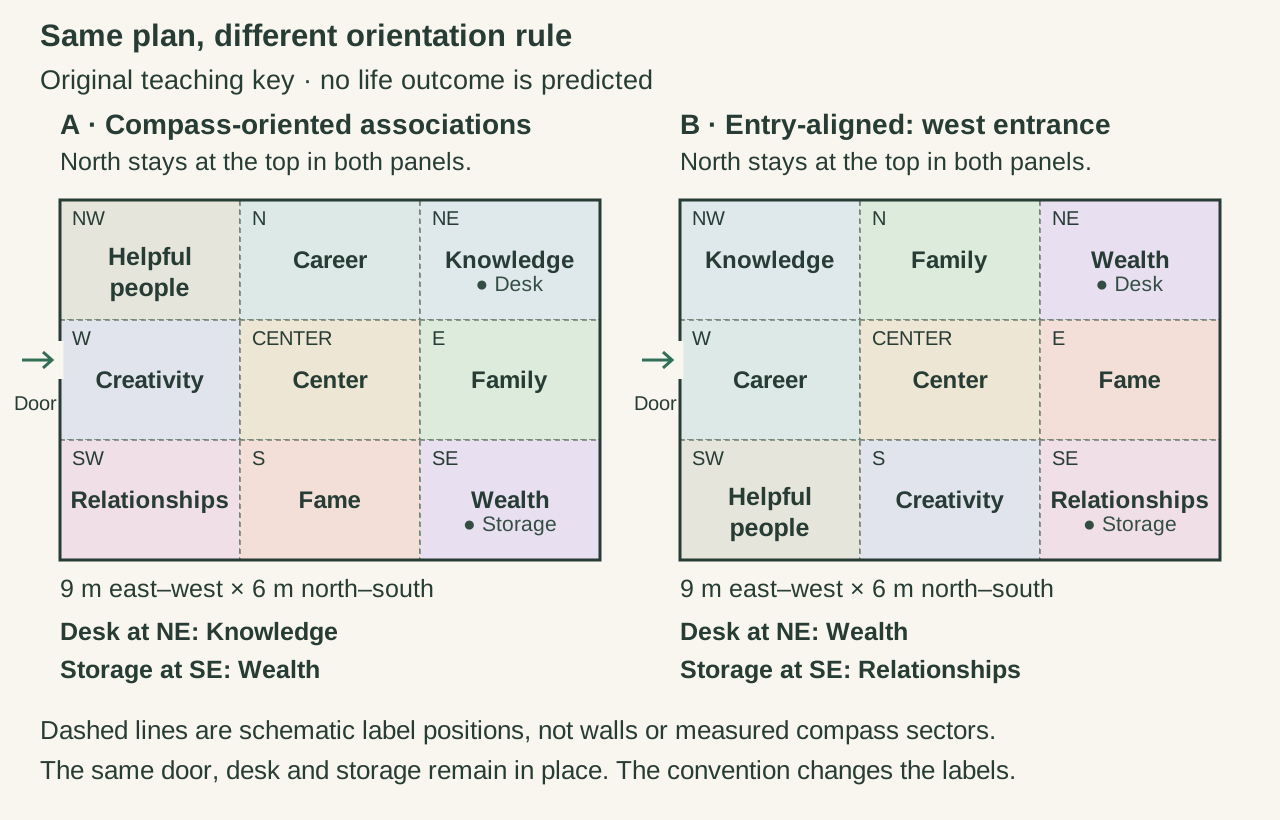
Download the original two-panel comparison. Both plans remain north-up so you can compare the same physical locations without mentally rotating the furniture.
A direction-based layout may use a sector or pie construction instead of equal rectangles. Feng Shui Nexus's methods article illustrates both nine-palace and pie approaches. The chart above is a deliberately limited association key; it does not resolve the center, angular boundaries or extra rules for a real compass reading.
Read panel A by directions
In the simplified compass association panel, north is career, northeast knowledge, east family, southeast wealth, south fame, southwest relationships, west creativity and northwest helpful people. The center is shown separately.
The desk is near northeast, so it receives the knowledge association. The storage is near southeast, so it receives wealth. The door lies at the middle of the west wall, within the schematic west position, so that position is creativity.
The door is not moved to north to satisfy a career label. Conversely, a door on another side would not make the entire direction key rotate around that door. The direction reference is what fixes these associations.
For an actual study of a home, record where the north reference came from and which procedure the teacher specifies. Do not treat an unverified floor-plan arrow, a guessed direction or this hypothetical diagram as a measurement. This guide does not instruct a professional compass survey.
Read panel B from the west-side entrance
Imagine entering from the west and looking east. Your left is north, your right is south, and the back of the outlined rectangle is east. In the entry convention used here, wealth is back left: that is the northeast corner of this particular north-up plan.
The desk therefore receives wealth. Relationships is back right, which is southeast here, so the storage receives that label. Career is front center, placing it at the west-middle entrance position.
The familiar entrance-side grid was rotated as a whole to place its front edge against the west wall. The physical floor plan and furniture stayed still. This is why the same object can have a different symbolic label without its direction changing.
A doorway near one end of the entrance-side wall can fall in a front-left or front-right position. Do not slide the grid until every doorway occupies career. For a separate detailed apartment exercise with fixed rooms and crossing furniture, use the entry-aligned studio worksheet.
Compare objects instead of arguing about an unlabeled corner
| Fixed location in this example | Compass association key | West-entry-aligned key | What remains true |
|---|---|---|---|
| Northeast desk | Knowledge | Wealth | Its work surface, lighting and access need practical assessment. |
| Southeast storage | Wealth | Relationships | It is still storage, with the same dimensions and contents. |
| West-middle door | Creativity | Career | The door and route must remain usable. |
This table answers “Why did the two maps disagree?” It does not tell you which label has a stronger effect. A change in naming is not evidence of a change in a resident's life.
If the desk is covered in papers, improve document access for that observed reason. You can use a symbolic label as a reminder if you like, but the label does not turn tidying into a wealth treatment or a promise of academic success.
A south-up chart is not a different north direction
Some traditional diagrams are printed with south at the top. A page's visual top and the direction north are separate concepts. Read the compass letters rather than copying “top left” onto another plan.
In a south-up direction chart, its upper-left southeast association can be wealth. On a north-up diagram, southeast is lower right. Moving the whole direction chart consistently is different from mirroring one row or assigning labels by whichever visual corner seems familiar.
The entry-aligned chart has a different reference: its printed bottom edge commonly means the chosen entrance side. That edge need not be geographic north. Write “entrance side” where that is what you mean.
The source background's discussion of Earlier and Later Heaven also warns against assuming every trigram diagram is the same arrangement. A decorative bagua mirror is not automatically a home-layout instruction or an instrument for measuring direction.
Keep different exercises separate
If you want to compare both methods, draw two labeled copies of the same outline. Keep one method consistent on each. Do not select the entry-aligned wealth corner and the compass career corner, then describe the combination as a single map.
Also name the boundary: an apartment unit, a whole building and one room are different outlined spaces. The lobby door and the unit door are different entrances. The worked example uses one unit and its west-side door; another choice must be stated explicitly.
Not every front-door-related rule is the same nine-area overlay. The Feng Shui Nexus article also discusses a separate visible-corner approach. A rule about a corner seen from a doorway should not be silently imported into a different entrance-side grid.
A compass approach may distinguish a building's facing from the direction of its front door, as that methods article explains. The simple direction-association key here does not calculate facing, personal Kua directions or annual Flying Star arrangements.
Choose a scope you can explain without life predictions
If your purpose is to explore an entrance-based reflection exercise, use a clearly named entrance convention and record its assumptions. If you are studying a compass school's teaching, follow that school's actual procedure rather than using an entrance worksheet as a substitute.
An irregular outline, angled entrance or uncertain north reference can leave questions unresolved. Record the uncertainty rather than inventing a missing-area diagnosis. A complicated layout is not evidence of bad luck, a relationship problem or a need to purchase a cure.
Practical room needs remain: usable access, comfortable lighting, stable furniture and the needs of the people sharing the space. A symbol does not settle those trade-offs. Any proposed change should have a room-use reason and be judged by what becomes easier or harder in ordinary use.
The useful result is a readable record of method and assumptions. It does not certify a home, verify practitioner outcome claims or guarantee health, money or relationships.
Download a method-comparison record
Download the editable comparison record. It keeps the boundary, entrance, north reference, method, object and uncertainty beside the two labels. Use one physical location at a time.
Space and entrance chosen: _________________________
North reference: measured / assumed / uncertain
Method and actual alignment rule: __________________
Object and location: _______________________________
Compass association: _______________________________
Entry-aligned association: _________________________
Real room-use problem and reversible change: _______
This original worksheet has no compatibility or luck score. You can appreciate the cultural associations while keeping them separate from measured room conditions and personal outcomes.
Six orientation checks with explained answers
These original checks use the stated north-up, west-entry example. They test interpretation of diagrams, not feng shui results.
Case 1
Your plan is north-up and its entrance is on the west wall. Is the entrance automatically the north or career direction?
Show answer and explanation for case 1
No. Page orientation and entrance alignment are different references.
In the compass association key, west is creativity. In the chosen entry-aligned example, the west-middle entrance is career. The physical direction did not change.
Case 2
The northeast desk is knowledge in one panel and wealth in the other. Does that disagreement show something is wrong with the home?
Show answer and explanation for case 2
No. The conventions assign labels differently.
A compass association follows direction; the entry-aligned grid follows position viewed from the chosen entrance. Neither label diagnoses the resident or predicts an outcome.
Case 3
You find a traditional chart with south at the top. Can you copy its top-left wealth label onto the northwest corner of a north-up plan?
Show answer and explanation for case 3
No. Read the direction labels and reorient the whole diagram consistently.
South-up top left is southeast in that layout. Copying a visual corner without tracking its direction can put an association in the wrong place.
Case 4
You prefer the entry-aligned wealth area but the compass career area. Can you keep both and present it as one method?
Show answer and explanation for case 4
Keep two separate labeled exercises instead.
Selecting individual cells from different orientation rules creates a hybrid that no longer follows either stated convention. A preference does not reconcile the rules.
Case 5
The unit door differs from the building lobby entrance. Which should you use without further explanation?
Show answer and explanation for case 5
State the boundary and the entrance for the chosen exercise.
The worked comparison maps one unit and its west-side door. Another boundary is a different exercise; do not switch silently between unit, building and room.
Case 6
A compass-oriented nine-box key is available. Does it contain every rule needed for a classical compass consultation?
Show answer and explanation for case 6
No. It shows selected associations only.
Classical practices can use sector geometry, facing and other school-specific inputs. A simple key does not perform those measurements or establish their conclusions.
Sources and further reading
- International Feng Shui Guild: The Feng Shui BaguaNine positional labels and eight direction associations; practitioner context, not proof of life-outcome or body-organ claims.
- Bagua: Earlier Heaven, Later Heaven and Western bagua backgroundDifferent trigram arrangements, south-up context and compass/main-door branches of Western eight-aspirations practice.
- Victor Cheung, Feng Shui Nexus: Five methods for locating wealth areasMethods 1 and 3 illustrate grid/pie options and door-versus-facing distinction; method 5 differs from a nine-area entrance overlay. Outcome, cure, annual-star and personal-direction advice is not adopted.
- Jan Cisek: Classic compass and three-door gate bagua comparisonPractitioner descriptions of classic compass and three-door gate naming and orientation. Used for terminology, without adopting historical priority, school rankings or manifestation claims.