Practical guide
Can Two Door Swings Collide? Check Both Leaves Together
Two doors can each clear furniture yet collide with one another. Work a complete two-leaf example, distinguish simultaneous states from swing envelopes, and keep actual installation requirements attached to the plan.
Check both doors in the same state
Yes. Two doors can each miss the furniture when checked alone and still meet one another when both are open. The second moving leaf is another obstacle. A furniture-only check leaves that interaction unanswered.
This guide gives a complete original two-dimensional example: two hypothetical 800 mm leaves, with hinges 1200 mm apart. They do not intersect when closed, but cross at a particular intermediate pair of angles and overlap when fully open. The calculation rejects those joint states in the stated model. It does not approve an installation or specify an acceptable access width.
Start with the actual doors and their intended use. A symbolic room plan or a drawing of only closed leaves does not identify all occupied positions. The many-doors room guide helps organize traffic and room use; the calculation here focuses on the simultaneous leaf geometry.
Record hinges, full leaf outlines and operating states
Choose one coordinate system and unit. Record the hinge reference for each leaf, its full outside outline, the permitted opening direction and the states people actually use. Add handles and other protrusions at the height where they can meet. Keep missing measurements visible rather than assume two catalogue widths describe the installation.
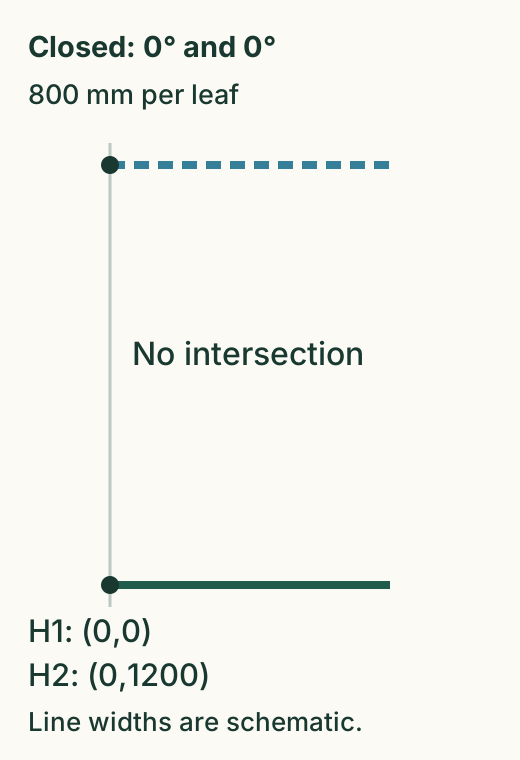
For our fictional calculation, use millimetres. H1=(0,0) and H2=(0,1200); positive x points right and positive y points up. Each ideal leaf is a zero-thickness segment of length 800 mm. Both closed segments point right. Door 1 turns counterclockwise towards +90°; door 2 turns clockwise towards −90°. We compare them in the same plane and count any shared point as an ideal geometric conflict.
These conditions define the example, including the reference edges and angle signs. Real doors have thickness, offsets, stops and hardware; different heights or swing directions can change the answer. Do not take the visible stroke width in the diagrams as a product thickness.
Calculate a joint conflict between the closed and open states
When both leaves are closed, door 1 runs from (0,0) to (800,0), and door 2 from (0,1200) to (800,1200). Their y coordinates differ, so these two complete segments are disjoint.
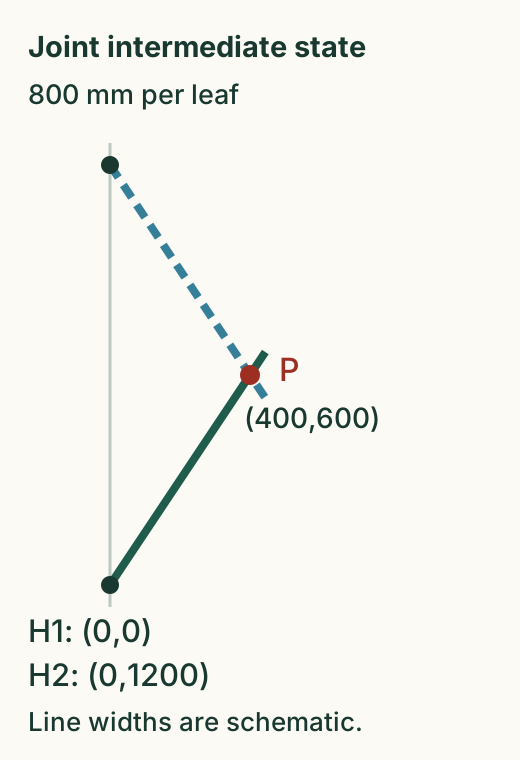
Now consider P=(400,600). Its distance from H1 is √(400²+600²)=721.110255 mm. From H2 the difference is (400,−600), giving the same distance. Both distances are less than the 800 mm leaf length; the point lies before the tip of each leaf, rather than beyond either segment.
The lower ray points towards P at θ=atan2(600,400)=56.309932°. The upper ray points towards it at −θ. At these simultaneous angles, door 1’s tip is approximately (443.760,665.640) and door 2’s tip (443.760,534.360). P lies on both finite segments, about 721.110 mm from each hinge, leaving about 78.890 mm of leaf beyond the crossing. Those joint positions therefore intersect in the ideal model.
The displayed decimals are rounded from this constructed calculation. They do not imply that a real hinge or door can be measured or set to that precision. Recheck the actual dimensions and their uncertainty.
Compare the complete leaves, not only their tips
At full opening, door 1 occupies x=0, y=0–800 mm. Door 2 occupies x=0, y=400–1200 mm. The overlap is the interval y=400–800 mm, with length 400 mm. Checking only the two different tip positions, (0,800) and (0,400), would miss the shared middle portions.
1. Both closed
2. A shared intermediate point
3. Both fully open
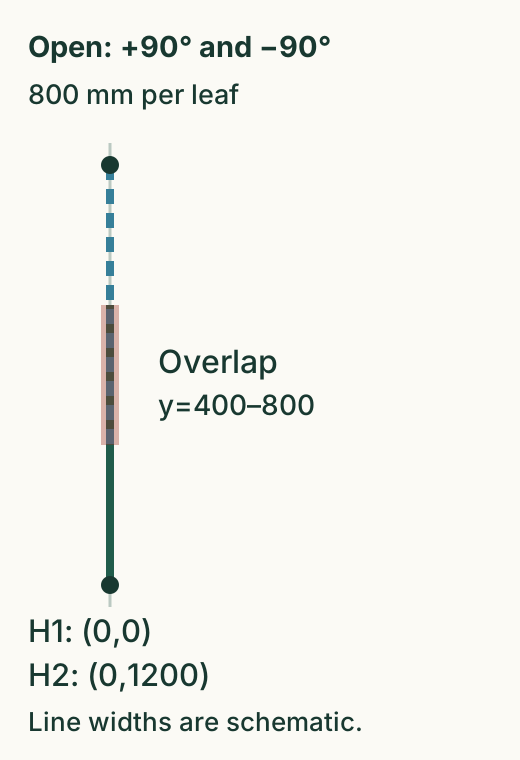
All three diagrams show the same hypothetical hinges and leaf lengths. Solid green is door 1; dashed blue is door 2. Red marks a shared point or interval. The full coordinates, input conditions and calculations are supplied in the text so the result does not depend on reading the drawing alone.
| State | Door 1 | Door 2 | Shared geometry and conclusion |
|---|---|---|---|
| Both closed | (0,0)→(800,0) | (0,1200)→(800,1200) | None; this one state is disjoint. |
| Joint intermediate angles | +56.309932°; tip ≈(443.760,665.640) | −56.309932°; tip ≈(443.760,534.360) | P=(400,600) lies within both leaves; ideal conflict. |
| Both fully open | (0,0)→(0,800) | (0,1200)→(0,400) | x=0,y=400–800; ideal conflict. |
| Door 1 fully open, door 2 closed | (0,0)→(0,800) | (0,1200)→(800,1200) | None; the first leaf does not reach y=1200. |
On a phone, swipe within the table to read the last column. Keyboard users can focus the table region and use the arrow keys. Passing the fourth state says nothing about subsequently opening door 2 while door 1 remains open.
Separate a sweep overlap from a simultaneous collision
A swing envelope contains all points occupied by one leaf over its allowed motion. Here each envelope is a quarter disk: x≥0,y≥0,x²+y²≤800² for door 1; x≥0,y≤1200,x²+(y−1200)²≤800² for door 2. At y=600 the two envelopes both contain x=0–√(800²−600²), approximately 0–529.150 mm. They share a substantial region.
Envelope overlap identifies positions that may conflict. It does not, on its own, prove that two actual leaves occupy that region at the same time. In this example the explicit pair of opposite 56.309932° angles supplies that simultaneous intersection. A different schedule might avoid that state, but a drawn schedule is not an approved practical arrangement for real doors, users or access needs.
For a specified joint movement, retain both leaf positions as time changes. One failed intermediate pair is enough to reject that movement. A few passing snapshots cannot generally prove every intervening pair is clear. If one leaf is genuinely fixed throughout, compare the moving leaf’s entire sweep against that fixed leaf and the other full obstacles.
A simple bound can also prove a limited geometric separation. With these same 800 mm ideal leaves but fictional hinges 1800 mm apart, any point on either leaf is at most 800 mm from its hinge. The two enclosing full disks are disjoint because 1800>800+800; their minimum separation is 200 mm. Thus the two zero-thickness leaves cannot intersect, regardless of their angles. This separate calculation concerns the leaves only and leaves actual hardware, people and required access unverified.
Use the calculation to identify the next check
Record the full door outlines and the operating states needed in your room. Draw both leaves together in each stated configuration. Include the actual fixed furniture, storage fronts and protrusions, keeping floor overlap distinct from a conflict at a different height.
Label a demonstrated conflict with the positions that cause it. If you have only a closed plan or incomplete dimensions, label the interaction unresolved. Obtain the actual installation and operating instructions before choosing an arrangement or changing hardware. Do not force a door past an obstruction or alter a fire door based on this worksheet.
USFA’s home escape-plan guidance says to map actual doors and windows and keep them unblocked. Retain the actual building arrangements and applicable local requirements. No value in this fictional geometry establishes an approved passage, installation clearance or escape route.
Keep measurements, simultaneous states and remaining unknowns together.
Open the blank door-state recordCase 1
Both leaves miss the furniture and are disjoint when closed. Have their simultaneous opening states been checked?
Show answer and explanation for case 1
No.
The furniture and closed-state checks omit interactions between the two moving leaves. In the complete example both leaves contain (400,600) mm at opposite 56.309932° angles.
Case 2
Do overlapping swing envelopes automatically prove an actual same-time collision?
Show answer and explanation for case 2
No; they identify potentially shared space.
Two drawings can represent different times. The example establishes an ideal simultaneous conflict by supplying the exact pair of leaf angles and verifying that the same point lies within both finite segments.
Case 3
With two 800 mm ideal leaves and hinges 1800 mm apart, does the disjoint-disk bound approve the real installation?
Show answer and explanation for case 3
No.
The 200 mm separation bound verifies only that the specified zero-thickness leaves cannot intersect. Real outlines, hardware, height, people, operating instructions and access requirements remain separate checks.
Sources and further reading
- NIST: SI Units – LengthMetric unit relationships; references checked November 8, 2026. Units do not establish measured precision or an installation clearance.
- USFA: Home Fire Escape PlansMap actual doors and windows and keep them unblocked; page reviewed April 10, 2025, reference checked November 8, 2026. It does not supply this original geometry or a universal access width.