Practical guide
Does Angling Furniture Save Space? Calculate the Rotated Footprint
Calculate both room-axis dimensions before angling a rectangular desk or bed. A small turn can increase both extents; the worked example shows which angles fit one empty test region and which checks remain.
Name the rectangle, axes and angle first
Angling furniture does not automatically save space. A rectangular footprint can become wider and deeper at the same time. Calculate its projection onto the room’s two axes, then compare the result with the actual available shape. A visual diagonal in a photograph is not a measured fit.
Let W be the full rectangle’s width and D its depth. The angle here is measured counterclockwise from the room’s horizontal drawing axis to the width edge. At 0 degrees, the width edge is horizontal; at 90 degrees, it is vertical. These are drawing coordinates, not compass or feng shui instructions.
Use the full outside footprint, including projecting parts that matter at the checked height. If the object is not rectangular, use its measured outline instead. An enclosing rectangle can conservatively reject a shape that might otherwise fit; it cannot describe a protrusion omitted from the input.
Add the two edge projections
For angles from 0 to 90 degrees, each projected extent is the sum of one contribution from each edge. The width edge contributes W cosθ horizontally and W sinθ vertically. The perpendicular depth edge contributes D sinθ horizontally and D cosθ vertically.
Projected depth = W sinθ + D cosθ
Outside that angle range, use absolute values for both projected contributions. Put a calculator in degree mode if you enter degrees. A value of 60 radians describes a different angle from 60 degrees.
The rectangle’s area remains W×D when rotated. Its axis-aligned bounding box usually changes area because it includes empty triangular regions around the object. Do not confuse those regions with additional furniture material—or assume they are all available for other objects without checking the actual outlines.
Compare the same footprint at seven angles
Take a wholly fictional rectangular desk footprint of 1800×600 mm. The empty test region is 1550 mm wide and 1900 mm deep. This is only a rectangular containment exercise: no chair, door, window, route, installation requirement or commercial desk has been included.
| Angle | Projected width | Projected depth | Fits the empty 1550×1900 mm test rectangle? |
|---|---|---|---|
| 0° | 1800.0 mm | 600.0 mm | No |
| 15° | 1894.0 mm | 1045.4 mm | No |
| 30° | 1858.8 mm | 1419.6 mm | No |
| 45° | 1697.1 mm | 1697.1 mm | No |
| 60° | 1419.6 mm | 1858.8 mm | Yes, containment only |
| 75° | 1045.4 mm | 1894.0 mm | Yes, containment only |
| 90° | 600.0 mm | 1800.0 mm | Yes, containment only |
A small turn to 15 degrees increases both projected dimensions from the 0 degree values. At 45 degrees, each extent is 1200√2, approximately 1697.1 mm. The desk’s 1.08 m² area is unchanged, but its bounding box is 2.88 m². That 45 degree candidate is wider than the 1550 mm test region.
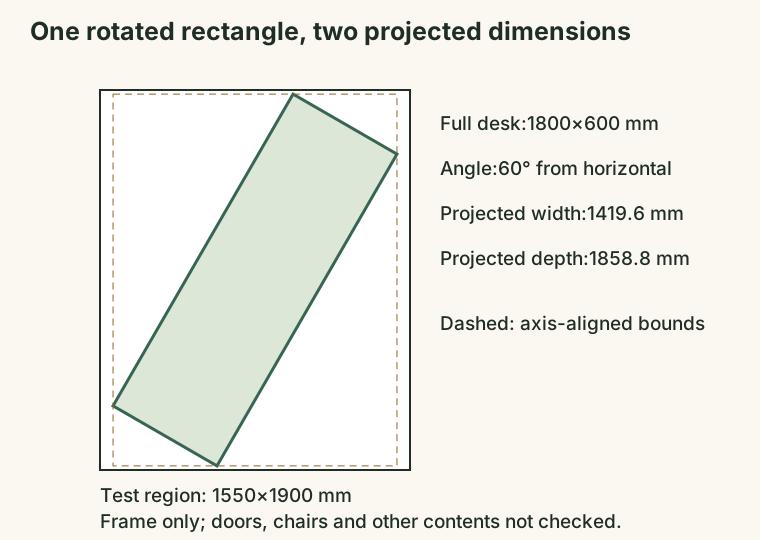
At 60 degrees, the projected width is 900+300√3=1419.6 mm; the projected depth is 900√3+300=1858.8 mm. Both are within the example region. This establishes only that the full rectangular footprint can be placed inside that empty rectangular region.
Place the bounds and then check the real operations
Place the 60 degree example at centre (775, 950) mm. Its horizontal limits are approximately 65.2–1484.8 mm; its vertical limits are 20.6–1879.4 mm. The four exact coordinates can be constructed by adding and subtracting half of each rotated edge vector from that centre.
The small vertical remainder is not an approved gap. Add the actual chair-use zone, desk drawers, door sweep, window operation and any required clearance. These may reject the candidate even though the isolated frame fits. Check the same required operations for every angle.
A final orientation also says nothing about the path needed to carry, assemble or rotate an actual object into that position. Keep delivery, installation and product instructions separate. Do not force a heavy item through a failed gap or alter a fitting to imitate the drawing.
Know when the rectangle model is insufficient
A rectangular test region is not the same as an irregular room. A bounding box may cross a fixed recess or obstruction. Check the entire outline and its position, not only two extents. Conversely, space outside the furniture’s rotated rectangle may be usable when its actual shape and all operations are accounted for.
Measurement ranges matter when a remaining dimension is small. Use the fit-range guide rather than treating rounded one-decimal outputs as exact measured clearance. The table is rounded for reading; the calculation uses unrounded trigonometric values.
USFA advises mapping actual doors and windows and keeping them unblocked. Retain the actual building and local requirements. A cultural preference for an angle or direction does not settle those conditions. The useful result is a quantified candidate or a quantified rejection, followed by the remaining checks.
Download the blank rotated-footprint record
Case 1
At 45 degrees, does an 1800×600 mm desk become narrower than 1550 mm?
Show answer and explanation for case 1
No: the projected width is 1697.1 mm.
(1800+600)/√2=1200√2. The 1800 mm edge becoming less horizontal does not remove the 600 mm edge’s projection.
Case 2
At 60 degrees, the frame fits the empty example rectangle. Is the room layout approved?
Show answer and explanation for case 2
No.
Only isolated rectangular containment was checked. Chair use, openings, access, other contents and instructions remain.
Case 3
Does the 45 degree bounding-box area of 2.88 m² mean the desk itself grew?
Show answer and explanation for case 3
No; its area stays 1.08 m².
Rotation preserves the actual rectangle’s area. The bounding box includes surrounding empty triangles.
Sources and further reading
- NIST: SI Units – LengthMetric unit relationships and exact 25.4 mm per inch; updated 19 September 2025. Units do not certify a measured range or furniture clearance.
- USFA: Home Fire Escape PlansMap actual doors and windows and keep them unblocked; reviewed 10 April 2025. Follow the actual building and local arrangements; no universal passage width inferred.