Practical guide
Will Furniture Fit a Tight Gap? Calculate With Measurement Ranges
Calculate the smallest and largest possible gap from the actual measurement bounds. A small nominal gap can still hide an overlap; a positive range answers only the specific geometric check you have defined.
Measure the exact span and the complete frame
For a tight furniture fit, compare ranges rather than subtracting two convenient nominal numbers. The narrowest plausible space minus the widest plausible frame gives the smallest remaining gap. The opposite endpoints give the largest gap. If those results cross your criterion, the evidence does not yet settle the fit.
First identify what you are measuring: for example, the finished clear span between two fixed surfaces at the height where the full frame must pass or sit. A floor-to-floor wall distance is not automatically the space between skirting, handles or a projecting radiator. Check the relevant height and the entire object.
Obtain the full outside dimensions of the actual frame and configuration. A mattress label or a product family name is not that measurement. Include an extra projection only if it is outside the stated full dimension; otherwise you would count it twice. Keep required product clearances separate from the frame itself.
The ranges below are explicitly fictional inputs. A range is useful only if its endpoints have an adequate basis. Do not invent “±10 mm” to make an uncertain listing look trustworthy. If you cannot establish an edge or a frame size, mark that input unresolved.
Calculate the smallest and largest remaining gap
Let Smin and Smax be the plausible bounds of the relevant space. Let Fmin and Fmax be the bounds of the full occupied span. Use the same unit throughout. This calculation is a bound under the stated inputs, not a confidence interval or a probability of success.
Maximum gap = Smax − Fmin
This takes the least favourable space/frame combination for the minimum and the most favourable combination for the maximum. If measured quantities share a dependency, such as two offsets from the same uncertain reference, document it. Treating all endpoint combinations as possible may be conservative; it is not a reason to quietly replace the minimum with an average.
NIST gives 10 mm per centimetre, 1000 mm per metre and exactly 25.4 mm per standard inch. Thus 79 in converts to 2006.6 mm exactly as a unit conversion. That decimal does not establish that the original measurement was accurate to a tenth of a millimetre. Keep the original measurement and its limitations beside the converted value.
Compare two complete hypothetical choices
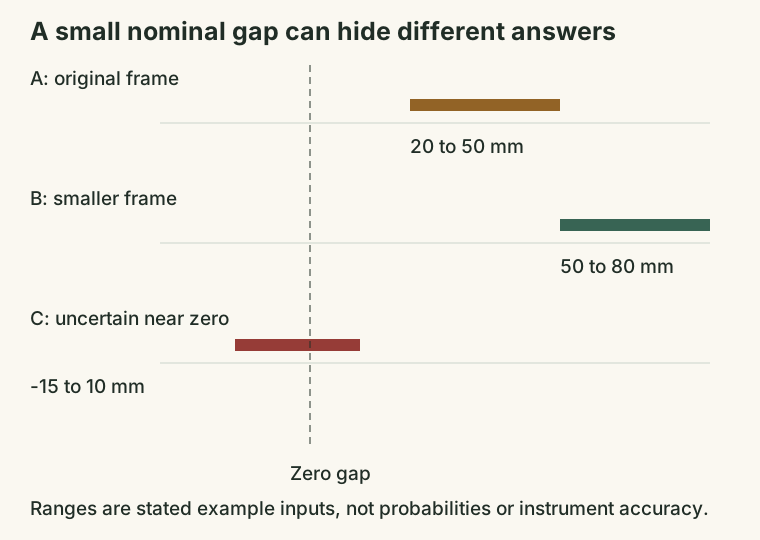
Suppose the relevant clear space is between 2010 and 2030 mm. Frame A is between 1980 and 1990 mm; frame B is between 1950 and 1960 mm. All four bounds are assumed for this example. Nothing here describes a commercial product or a measured home.
| Choice | Smallest gap | Largest gap | Result for a separately stated 35 mm target |
|---|---|---|---|
| A | 2010−1990=20 mm | 2030−1980=50 mm | Target remains unsettled:20<35≤50 |
| B | 2010−1960=50 mm | 2030−1950=80 mm | The stated range clears 35 mm; other checks remain |
| B plus extra 10–20 mm projection | 2010−(1960+20)=30 mm | 2030−(1950+10)=70 mm | Target becomes unsettled again |
The 35 mm target is an invented comparison input. It is not an accessibility, fire, manufacturer or bedside-clearance standard. For an actual decision, use the requirement relevant to the object, users and building; do not borrow this example’s number.
Choice B passes only the given gap criterion under the stated bounds. It may still fail an opening, installation, chair, route or height-dependent check. If the projection is already included in the full frame dimension, do not add it again.
Distinguish a pass, a conflict and an unresolved result
For a stated target T, the minimum gap at least T establishes that this range criterion is met. If even the maximum gap is below T, the candidate fails that criterion. Otherwise some stated combinations meet it and others do not: the result is unresolved. Equality should follow the real requirement; mere boundary contact is not a useful clearance claim.
For example, a space of 1980–1990 mm with a frame of 2000–2010 mm leaves −30 to −10 mm. Even the most favourable combination overlaps, so this one-dimensional candidate fails. A space of 1995–2010 mm with a frame of 2000–2010 mm leaves −15 to 10 mm: it may overlap or fit, and more reliable dimensions are needed.
The interval describes one span. It does not check the furniture’s route into the room, its final position or how occupants reach it. Follow actual building arrangements and keep doors/windows unblocked. A paper-fit result cannot replace those checks.
Reduce the uncertainty that changes the answer
Return to the limiting input before buying or moving furniture. Recheck the reference edges, finish projections and relevant height; obtain the actual configuration’s outside dimensions and operating instructions. Ask a specific question, such as whether the listed depth includes the handle or which surface the width was measured between.
If rechecking a space changes its bounds to 2020–2024 mm while A remains 1980–1990 mm, the gap becomes 30–44 mm. That narrower range still does not guarantee the fictional 35 mm target. Improving a measurement is useful only when it resolves the decision you actually need.
Record the bounds, their basis, the required criterion, the computed range and each remaining check. If the basis stays unknown, leave the result unknown. No heavy furniture movement or risky physical trial is needed to work through this arithmetic.
Download the blank fit-range record
Case 1
Space 2010–2030 mm, frame 1980–1990 mm: what is the smallest remaining gap?
Show answer and explanation for case 1
20 mm.
Use the smallest space and largest frame:2010−1990=20.
Case 2
The same choice has a nominal 35 mm gap. Can you guarantee the invented 35 mm target?
Show answer and explanation for case 2
No; the calculated range is 20–50 mm.
The centre-value calculation is not the worst case. The 35 mm target lies inside the range.
Case 3
A 79 in listing converts to 2006.6 mm. Does that prove tenth-millimetre measurement accuracy?
Show answer and explanation for case 3
No.
The unit factor is exact; the source dimension’s accuracy, resolution and completeness are separate.
Sources and further reading
- NIST: SI Units – LengthMetric unit relationships and exact 25.4 mm per inch; updated 19 September 2025. Units do not certify a measured range or furniture clearance.
- USFA: Home Fire Escape PlansMap actual doors and windows and keep them unblocked; reviewed 10 April 2025. Follow the actual building and local arrangements; no universal passage width inferred.