Practical guide
Check a Mirror’s Reflected View: A Complete Sightline Example
Mark the viewer, mirror and object you want to see or keep private. A complete ray model explains why facing a mirror does not show every object, and why changing the viewer or mirror size changes the answer.
Mark the viewer, mirror and target
A mirror can show something that is outside a direct view, but its position alone does not tell you what will be visible. Name the viewer’s actual location and the object of interest first. For privacy, that object may be a desk document or part of a bed. For a useful entrance view, it may be the doorway. Different targets produce different answers.
Use a labelled sketch before buying or moving a mirror. Record the mirror’s location and finite width, the viewer’s position, the target’s location, and any object that could obstruct the view. Keep eye height, target height and mirror height as separate measurements: a floor-plan drawing cannot settle them.
This guide explains an ideal flat, smooth mirror. It does not specify glass, brackets, load, anchoring or a permitted installation. A heavy mirror cannot be safely tested by balancing it against a wall; use the actual product’s instructions and suitable help for any physical work.
Use the mirror line and its normal
OpenStax describes reflection with equal incident and reflected angles, measured from the normal: a line perpendicular to the mirror at the reflection point. Measuring from the wall instead would use the complementary angle. Its plane-mirror explanation places a virtual image as far behind the mirror as the object is in front.
For a plan-view construction, reflect the target across the mirror line. Draw a straight line from the viewer to that virtual target. Where the line crosses the mirror is the required reflection point. Then check whether that point lies on the actual mirror segment. A point on the imaginary extension of a wall mirror does not supply a reflected view through the real glass.
The virtual target is a drawing aid. It does not mean a second object exists behind the wall, nor does it add usable floor area.
Complete example: one viewer, one target, a finite mirror
The following coordinates are an original fictional example in metres. The mirror lies on x = 0 and spans y = 2.00 to 2.50. The viewer is O = (2, 1); the target is T = (1, 3). Both are in front of the mirror, where x is positive. The virtual target is T′ = (−1, 3).
The line from O to T′ has coordinates (2 − 3t, 1 + 2t). It reaches x = 0 when t = 2/3, giving the reflection point P = (0, 7/3), or y ≈ 2.333. That lies inside the stated mirror span.
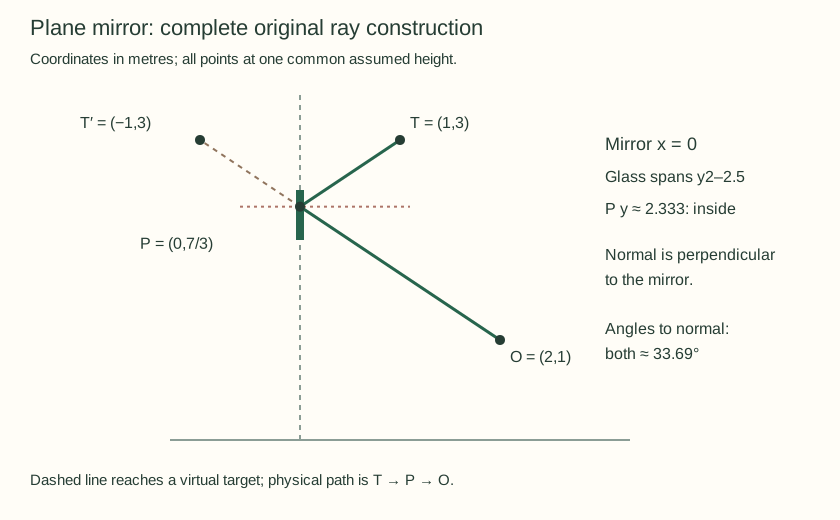
The physical light path is T → P → O. From T to P the vector is (−1, −2/3); from P to O it is (2, −4/3). The second is twice the vector obtained by reversing only the first vector’s perpendicular component. Both angles to the normal are approximately 33.69°. This checks the reflection rule as well as the intersection.
Change the viewer or glass, then repeat the check
| Changed input | Calculated reflection point | Ideal-model result |
|---|---|---|
| Original O = (2,1); mirror y2.00–2.50 | P y = 7/3 ≈ 2.333 | Inside the mirror segment. |
| Same viewer; shorter mirror y1.00–2.00 | P y = 7/3 ≈ 2.333 | Outside this segment; the required glass is absent. |
| Viewer moves to O = (2,2); original mirror | P y = 8/3 ≈ 2.667 | Outside the original segment. |
These results explain why one doorway photograph does not establish what a seated person sees. They also show why reducing mirror size or moving the viewer can change a particular reflected target. The model does not establish a wider field of view, exact visibility at an edge, or what happens to every other object in the room.
Check the real view, height and light separately
When an installed mirror can be observed without moving it, compare the actual view from the relevant positions. Use a private written note if a photograph would reveal personal information. Check the relevant target, other occupants’ views, obstructions and the mirror’s top and bottom edges. A privacy preference needs the affected person’s agreement.
A visible object and troublesome light are separate observations. CCOHS describes daylight as dependent on factors including the building, sun direction, clouds and season. Record the time and light condition rather than assuming a daytime sketch covers a night lamp or a different season. For a display, a reflected window and a bright background beyond the display need separate checks.
Keep the result narrow: “this viewer can see this target in these conditions.” If the height, permitted mounting or actual dimensions are unknown, leave that part unresolved. A feng shui preference can then be considered without presenting reflection geometry as proof of health, wealth or relationship effects.
Copy a reflected-view record
MIRROR VIEW RECORD
Viewer / task / actual eye height:
Target / position / relevant height:
Mirror location / width / bottom and top:
Obstructions and conditions not checked:
Sketch: virtual target / reflection point / finite glass:
Actual observed view / time / light conditions:
Privacy agreement / product or permission still needed:
Keep / compare another position / unresolved:
This is a blank record, not a report of a tested home. The calculations above are reproducible; a real room needs its own inputs.
Sources and further reading
- OpenStax: University Physics Volume 3, §1.2, The Law of ReflectionEqual angles relative to the normal, plane-mirror virtual image and the ideal smooth-surface model. Text paraphrased; no source figures or photographs reused.
- CCOHS: Lighting Ergonomics – GeneralGeneral/task lighting, daylight variability and glare; revised July 10, 2025. Workplace guidance, not a residential lux prescription.
- NIST: SI Units – LengthExact unit conversion; updated September 19, 2025. Not a furniture clearance standard.