Practical guide
Can a Mirror Show the Whole Doorway? Check Width and Height
Seeing the center of a doorway in a mirror does not establish that its floor edge, header and both sides are visible. For an ideal flat mirror, plot the reflected footprint of the entire chosen rectangle, check the finite glass in width and height, and repeat for each eye position.
Name the whole target and each viewer
If your aim is to see a whole doorway, define what “whole” means: the opening between specified side edges, floor level and header. If you only need to notice somebody approaching, that is a different and smaller target. Do not turn a full-doorway calculation into a requirement to buy a bigger mirror when your actual task needs less.
Record the actual reflective glass edges, rather than the decorative frame’s outer dimensions. Mark one viewer’s eye position, the target rectangle and a vertical, flat mirror plane. Keep the other viewer’s eyes as another input. A floor-plan sketch supplies width relationships but cannot settle the mirror’s bottom and top.
The single-point reflection guide explains how to locate one reflection point. This guide extends that calculation to a whole rectangular target in three dimensions. The example is original and fictional; it supplies no mounting height for your home or approval for a product installation.
Build the four-corner reflected footprint
OpenStax’s plane-mirror explanation treats an extended object as a collection of points. Each point has a virtual image at the same perpendicular distance behind the mirror. Its reflection law measures equal incident and reflected angles from the surface normal. Use those principles to trace the target’s corners.
For the example, x measures distance out from the mirror, y measures position along the wall, and z is height above the floor. All coordinates below are in metres. The mirror lies in the vertical plane x = 0. The seated eye is O = (3, 1.5, 1.2). A fictional doorway rectangle lies in the parallel plane x = 2, spans y = 3.0–3.9 and z = 0–2.0. There are no intervening obstructions in this model.
Reflect a corner T = (2, y, z) to T′ = (−2, y, z). The line from O to T′ meets the mirror three-fifths of the way along. At that point, P_y = 1.5 + 0.6(y − 1.5) and P_z = 1.2 + 0.6(z − 1.2). This is a line construction, not a light-meter measurement.
- For the two side positions, the required glass coordinates are y = 2.40 and 2.94.
- For the floor and header positions, they are z = 0.48 and 1.68.
- All four corner intersections therefore bound the required rectangle: y 2.40–2.94, z 0.48–1.68.
- Check that this entire rectangle lies within the actual reflective surface, then check clear paths on both sides of each reflection.
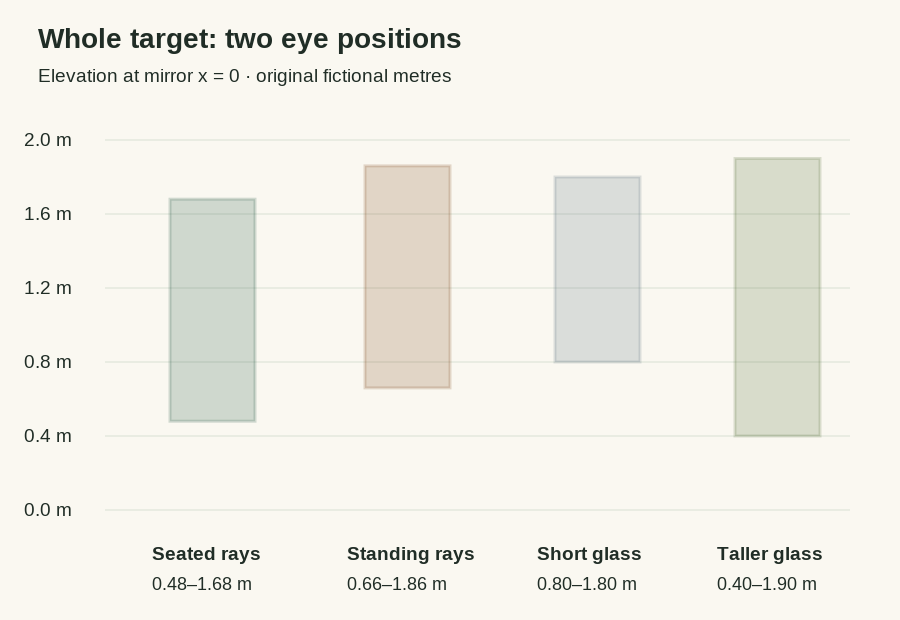
Why are four corners enough here? With a fixed viewer and a target plane parallel to the flat mirror, this intersection mapping is affine: it sends the filled target rectangle to a filled rectangle. The corner extrema bound every point between them. That conclusion depends on this particular convex, parallel-plane setup. It does not settle a moving person, a curved mirror, a nonrectangular target, a mirror tilted out of the stated plane or an intervening object.
Compare three glass height ranges
On a narrow screen, scroll this table sideways. Keyboard users can focus it and use the arrow keys.
| Actual glass height | Seated eye z 1.20 | Standing eye z 1.65 | Bounded conclusion |
|---|---|---|---|
| z 0.80–1.80 | Required z 0.48–1.68: lower part absent. | Required z 0.66–1.86: lower and upper parts absent. | Seeing the target center is insufficient for either whole rectangle. |
| z 0.40–1.80 | Whole required z 0.48–1.68 is inside. | Upper requirement reaches 1.86, beyond the glass. | Covers the seated rectangle in the ideal model; standing rectangle still incomplete. |
| z 0.40–1.90 | Whole required height is inside. | Whole required height is inside. | Covers both stated rectangles if the full paths and horizontal span are clear. |
For the standing eye O = (3, 1.5, 1.65), the horizontal result remains y 2.40–2.94 and the vertical result becomes z 0.66–1.86. Standing does not simply move every required point upward by the change in eye height: the line reaches the mirror at the same three-fifths fraction.
These are three mathematical candidate rectangles, not three recommended mirror products. Equality at an edge is an ideal-model boundary. A real decision needs actual measurements, tolerances, frame intrusion and observation; the example supplies no universal allowance in centimetres.
Repeat after moving the viewer
Original case 1 — the center gives a misleading answer: Maya uses the first glass range, z 0.80–1.80. For the doorway center T = (2, 3.45, 1.0), the seated reflection point is P = (0, 2.67, 1.08), inside that mirror. The center check passes, yet the required lower edge is z 0.48 and misses the glass. Her decision is “center visible in the model; whole doorway not established,” rather than a full-view pass.
Original case 2 — another viewer: Arun compares the second range, z 0.40–1.80. It contains the seated footprint, but his standing eye requires glass up to z 1.86. He records a separate incomplete standing result. Extending the drawing to z 1.90 would resolve this particular ideal-model height issue; it would still leave product mounting and actual observation to check.
Original case 3 — closer to the mirror: Maya moves her eye to O = (1, 1.5, 1.2). The line now reaches x 0 at fraction one-third. The required horizontal span becomes y 2.00–2.30, and the height becomes about z 0.80–1.467. A mirror whose width stays at y 2.30–3.05 lacks most of that new horizontal footprint. A height that looks suitable does not cancel a width failure.
All three cases use the same fictional target and declared geometry. They are worked calculations, not household observations. Rules about seeing your own full body cannot be transferred without checking a different target’s distance, position and required edges.
Use the real view and record what is unresolved
For an already safely installed mirror, compare the target from the actual seated and standing positions without moving the mirror. Use a non-sensitive target or a private note rather than posting a photograph of personal papers or somebody’s room. If you cannot establish the glass edges, viewer height or target bounds, mark that input unresolved.
The drawing does not decide installation. Use the named mirror’s instructions, actual wall conditions, permissions and suitable help for any physical work. Do not balance a heavy mirror on a temporary support to test a view.
A view being geometrically available is separate from whether its brightness or reflection is useful. CCOHS describes daylight as changing with the building, sun direction, cloud and season. For screen work, the window/display comparison separates reflected light from a bright background. A mirror used for an entrance view may also reveal a target somebody wants kept private; check that separately with the affected person.
Copy the blank whole-target record: viewer positions; target bounds; mirror glass bounds; corner intersections; clear or unresolved paths; actual observation and light conditions; installation information missing; decision for each viewer. It contains no prefilled room measurements. If the remaining question is a direct view around a screen, use the divider sightline guide. A feng shui preference can be recorded alongside the practical result without predicting health, wealth or relationship effects.
Sources and further reading
- OpenStax: University Physics Volume 3, §1.1 The Propagation of LightRay model: straight light paths between interactions. Source checked November 10, 2026.
- OpenStax: §1.2 The Law of ReflectionEqual angles relative to the normal and ideal smooth-surface reflection; no source figures reused.
- OpenStax: §2.1 Images Formed by Plane MirrorsVirtual images and extended objects as collections of points. The coordinates and affine boundary checks in this guide are original, not examples copied from the textbook.
- CCOHS: Lighting Ergonomics – GeneralChanging daylight and distinct task/general light; revised July 10, 2025. This workplace fact sheet does not supply a residential illumination standard.