Choose the path that matches the method label, input assumption, and whether the result matches a real room question; skip the rest until the situation changes.
tools-hub
Feng Shui Tools
Feng Shui Tools is the action shelf. Use the checklist, Bagua explainer, Kua estimate, or annual map when you need a bounded result before choosing a guide; no tool stores personal inputs. Read the assumptions first, then open the related page only if the result matches a visible room question.
Choose by the decision in front of you
Open the path that matches the visible room signal or learning gap; skip the rest until it becomes useful.
Use this when you need one first move.
Room checklist
First choose bedroom, office, entryway, kitchen, or another room.
Use this when sector advice conflicts.Bagua method chooser
First choose front-door overlay or compass logic.
Use this for a beginner direction note.Kua estimate
First check birth year and solar-year boundary assumption.
Use this for a year and sector reading.Annual map
First choose the year and confirm date range.
Use this after the checklist points to sleep.Apply a result to the bedroom
First compare bed, door, mirror, and support.
Use this after reading a yearly sector.Apply the annual map carefully
First check active sectors and low-risk action.
What This Page Helps You Decide
The reader is choosing among several Feng Shui Tools paths and needs the hub to sort by visible situation instead of by a long list of similar articles.
Feng Shui Tools should help the reader choose a narrower path. Start with the method label, input assumption, and whether the result matches a real room question, then open only the guide, tool, or method note that matches the visible signal. The hub is written to prevent broad browsing from turning into a list of disconnected Feng Shui tips.
Identify whether Feng Shui Tools is answering a room problem, a tool need, a method question, or an annual timing question before opening another page.
Do not let Feng Shui Tools turn into a full-room makeover. If several changes happen at once, the reader cannot tell which one helped normal use.
Core reader path
Reader Questions This Page Answers
Feng Shui tools answers a reader who wants the page to be faster than a long article and more careful than a quick rule. Start with the method label, input assumption, and whether the result matches a real room question, compare whether the result points to a visible room condition rather than an abstract promise, choose one reversible action, and leave the room alone when the signal is not present.
Feng Shui tools should first answer a way to choose between checklist, Bagua, Kua, and annual tools. The useful answer is not a larger promise; it is the smallest room decision that becomes clearer after checking the method label, input assumption, and whether the result matches a real room question.
Use the page when whether the result points to a visible room condition rather than an abstract promise appears during ordinary use. If the signal is absent, the topic can stay as context and the reader should avoid changing the room only because the phrase sounds important.
Feng Shui tools now includes a practical first action, a visual comparison, FAQ-style objections, and source context. That makes the page useful for quick decisions while preserving the longer explanation below.
a tool result is not a final reading and cannot override the actual room. The page can support observation, vocabulary, and low-risk adjustment; it cannot verify luck, money, health, relationships, career, fate, or a guaranteed before-after effect.
Feng Shui tools needs a visual that clarifies the method label, input assumption, and whether the result matches a real room question, whether the result points to a visible room condition rather than an abstract promise, and the first low-risk action. The image or diagram should make the decision easier to inspect, not decorate the article.
Use the visual beside one real observation from the doorway or main position. If the image does not match the room, keep it as a checklist for door, anchor object, path, light, support, and constraint.
Feng Shui tools can support vocabulary, traditional context, visual room observation, and one reversible home decision around the checklist, Bagua grid, Kua estimate, or annual map output. It cannot turn that support into proof of a personal result, and it should still show why another method page or tool may be needed.
It cannot prove wealth, health, luck, relationship, career, fate, or a before-after outcome. It also cannot override building rules, safety, accessibility, lease limits, or professional judgment.
Which Feng Shui tool should I use first?
The room checklist fits physical problems, the Bagua explainer fits unclear map methods, the Kua calculator gives direction context, and the annual map belongs only to date-bound sector questions. The right tool should make the next room decision smaller, not more dramatic. If the result does not point to a visible room signal, read the related method page before moving furniture or adding objects.
Can a Feng Shui tool decide the room for me?
No. A tool should narrow the next check, not override the room. Treat the result as a prompt, then compare it with door view, support, path, light, safety, and ordinary use. If the room contradicts the output, the room wins. The useful next step is one reversible observation or adjustment, followed by a guide that explains the method boundary behind the result.
HomeReturn to the room-first starting point when the hub feels broad.Room Flow ChecklistTurn this topic into a practical room checklist. Use it after checking the method label, input assumption, and whether the result matches a real room question for Feng Shui tools, so the next click answers a real room decision instead of sending the reader into generic browsing.Annual Feng ShuiCompare this topic with the next related learning area. Use it after checking the method label, input assumption, and whether the result matches a real room question for Feng Shui tools, so the next click answers a real room decision instead of sending the reader into generic browsing.Bagua method chooserKeeps method assumptions visible. Use it before choosing the next page.Kua estimateMakes personal-direction limits visible. Use it before choosing the next page.
Choose Your Situation
For Feng Shui Tools, choose the situation that matches why you opened this page.
Renting with tools
Use rental-safe tools adjustments
Lease rules, budget, or fixed doors shape the tools decision.
Start here when tool results can feel more exact than the underlying tradition allows for a beginner page makes the ideal version unrealistic.Room answer for toolsCheck the matching tools layout
A bed, desk, chair, door view, or anchor object changes entering a small amount of information and reading the result with method boundaries visible.
Use the room guide when the checklist, Bagua grid, Kua estimate, or annual map output changes entering a small amount of information and reading the result with method boundaries visible.Quick fix for toolsRun the fastest tools check
One visible pressure around the checklist, Bagua grid, Kua estimate, or annual map output needs a first move.
Use this focused fix page before opening another broad guide or adding a second cure.Specific problem around toolsCompare the closest fix page
A mirror, door, beam, clutter point, line, or object keeps pulling attention.
Use the fix page when the visible problem matters more than the broad method.Annual check for toolsRead the annual sector carefully
The tools question depends on year, sector, date range, or activity level.
Use annual guidance only after checking date and sector activity.Method first for toolsSeparate the method before acting
Two sources disagree or mix schools around tools.
Use this before blending form, Bagua, compass, Kua, or annual advice.Before You Change Anything
Use this page like a careful directory, helping readers choose one real question instead of browsing every article. Start with tools as a real room question before moving into theory. The practical room signal, Feng Shui method, and cultural boundary should stay close together so the reader does not have to chase separate tips.
Room situation
The reader is likely standing inside an interactive explainer used before deciding what to change in a room, trying to make entering a small amount of information and reading the result with method boundaries visible feel less confusing while the checklist, Bagua grid, Kua estimate, or annual map output keeps pulling attention. They need a first check they can see, not another abstract promise about luck.
Likely question
The likely question is practical and skeptical: the visitor wants a direct answer, a visible room diagnosis, one low-risk next move, and enough method context to avoid fear-based or shopping-first advice.
Why this guide helps
Feng Shui Tools helps because it starts near a common entry point: the method label, input assumption, and whether the result matches a real room question. It can send readers toward the right room guide, tool, source note, or cultural explanation without pretending that one page can replace a full consultation.
Visual check
Use the diagram as a concrete visual anchor for the checklist, Bagua grid, Kua estimate, or annual map output. It should help the reader compare the method label, input assumption, and whether the result matches a real room question, whether the result points to a visible room condition rather than an abstract promise, and the suggested room or tool action without implying a guaranteed outcome.
Manual checks
- The answer starts with a visible room signal before symbolic interpretation.
- The method boundary names the Feng Shui school or assumption shaping the advice.
- The next step is reversible and observable during ordinary home use.
- The source and visual notes explain what the page can and cannot prove.
Source anchors
- Tools method boundary: supports Tool pages keep method differences visible and avoid presenting one calculator as a universal Feng Shui truth. It supports the page's choice to name the method before giving advice. Limitation: It does not prove a personal result, replace a practitioner reading, or make every Feng Shui school agree.
- Tools room-use evidence: supports The page's practical reading starts with the method label, input assumption, and whether the result matches a real room question. It then looks for this visible signal during ordinary use: whether the result points to a visible room condition rather than an abstract promise. Limitation: It is a home-observation standard, not a measured study of money, health, relationships, career, or fate.
- Tools safety and constraint boundary: supports The low-risk action is limited by tool results can feel more exact than the underlying tradition allows for a beginner page, accessibility, rental rules, maintenance, and the room's real function. Limitation: It does not override building codes, medical advice, accessibility needs, fire safety, lease rules, or professional judgment.
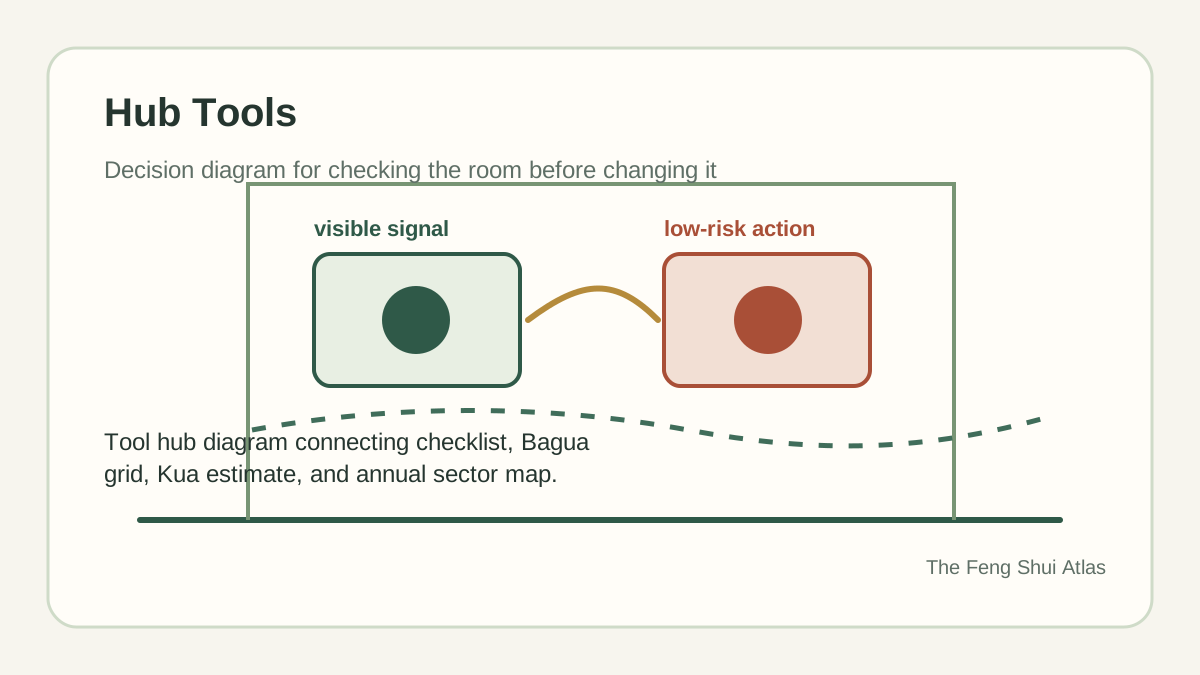
- top30-hub-tools visual source: supports Tool hub diagram connecting checklist, Bagua grid, Kua estimate, and annual sector map. It supports visual comparison before the reader moves furniture or decor. Limitation: It is an editorial diagram or contextual image, not a before-after proof, client case study, or guaranteed outcome.
Editorial Note
Room moment
The useful version of feng shui tools starts in an interactive explainer used before deciding what to change in a room: the reader notices how the suggested action changes use, light, access, privacy, or calm in the room around the checklist, Bagua grid, Kua estimate, or annual map output during daily use in an ordinary room, while a desk, bed, mirror, plant, or cabinet is already doing two jobs in the same room.
Exception
If safety, lease rules, access, cleaning, light, or shared routines conflict with the advice, let the room requirement win.
Editor judgment
Editorial judgment: Keep the recommendation narrow enough that a renter, small apartment, or busy household can actually try it this week.
Lived constraint check
Test feng shui tools in an ordinary constraint, such as a 700-square-foot apartment where the front door opens straight into shoes, coats, and a dining chair, where two people use the same chair, mirror, cabinet, or doorway at different times of day and the anchor piece cannot move without breaking the safer walking path or creating a worse reflection line.
The useful question is not whether the room matches a perfect diagram. It is whether the method label, input assumption, and whether the result matches a real room question, whether the result points to a visible room condition rather than an abstract promise, and the checklist, Bagua grid, Kua estimate, or annual map output still support the people who actually live with the space.
Smallest move: mark the doorway view, clear one 24-inch path, and test a lamp, screen, textile, or storage reset before moving anchor furniture.
Do not force it: undo the change if after a week the room is prettier but no easier to use, clean, enter, sit, sleep, cook, or work in.
Source and Method Check
For Feng Shui Tools, this page uses traditional Feng Shui context plus visible room observation. It is not a scientific guarantee, a promise of personal results, or a reason to ignore safety, lease rules, light, access, or daily use.
Tools language is treated as a traditional spatial vocabulary for Feng Shui tools, not as a prediction system.
The practical reading starts with the method label, input assumption, and whether the result matches a real room question. It then looks for this visible signal during normal use: whether the result points to a visible room condition rather than an abstract promise.
School differences, compass readings, Bagua overlays, Kua directions, and annual timing are named when they matter, but they do not override visible room evidence.
This page is not evidence of wealth, health, relationship, career, fate, medical, legal, financial, or guaranteed personal outcomes.
Diagrams and room images are used to compare the checklist, Bagua grid, Kua estimate, or annual map output, support, path, light, clutter, and maintenance before changing decor.
References used for this pagesite methodEditorial method encyclopediaLighting context cultural referenceQi term context design referenceUniversal design context visual sourceOriginal visual method note
Feng Shui tools should lead to one observable room decision, not a blended rule made from every Feng Shui school at once.
The method page is an editorial policy; it is not a practitioner credential, client case study, certification, or scientific outcome study.Feng Shui tools is treated as a bounded educational topic: the page uses the reference to name the idea, then asks whether the method label, input assumption, and whether the result matches a real room question and whether the result points to a visible room condition rather than an abstract promise are visible in the room.
The reference does not prove that feng shui tools creates wealth, health, relationship, career, fate, or any guaranteed personal outcome.Feng Shui Tools uses this reference to compare the method label, input assumption, and whether the result matches a real room question, whether the result points to a visible room condition rather than an abstract promise, and the checklist, Bagua grid, Kua estimate, or annual map output before recommending a small change.
This reference does not validate a personal reading, replace an on-site professional, or prove that the suggested action will create a guaranteed result.Feng Shui Tools uses this reference to compare the method label, input assumption, and whether the result matches a real room question, whether the result points to a visible room condition rather than an abstract promise, and the checklist, Bagua grid, Kua estimate, or annual map output before recommending a small change.
This reference does not validate a personal reading, replace an on-site professional, or prove that the suggested action will create a guaranteed result.The selected image supports tools because it gives the reader a visual anchor for the method or room pattern discussed here. The image helps the reader compare a doorway view, pressure line, anchor object, or maintenance cue before changing the room.
The visual is a reading aid, not a real client before-after record, practitioner endorsement, measured effect, or promised result.What this hub is for
Browse tools and choose one practical Feng Shui question that matches a real room or learning need.
For modern homes, this hub turns tools into readable diagrams, cautious explanations, and practical alternatives for renters or fixed layouts.
What This Page Helps You Decide
Tools is written for a reader who needs one practical decision, not a mystical diagnosis. It starts with the method label, input assumption, and whether the result matches a real room question, uses the checklist, Bagua grid, Kua estimate, or annual map output as the visible anchor, and ends with a low-risk next step that can be observed in normal use.
Reference anchors
- Chinese term definitions and English-language Feng Shui school explanations
- Room-form examples that show door view, support, path, light, and clutter
- Method comparisons between form school, BTB Bagua, compass use, Kua, and annual timing
Decision path
- Confirm the room signal
Look for whether the result points to a visible room condition rather than an abstract promise. If the signal is not visible in the room, keep the page as background reading instead of changing furniture or decor.
- Name the method
Tool pages keep method differences visible and avoid presenting one calculator as a universal Feng Shui truth. This prevents the page from mixing a form-school room fix with Bagua, compass, Kua, or annual advice without saying so.
- Choose one reversible move
The useful action should improve entering a small amount of information and reading the result with method boundaries visible around the checklist, Bagua grid, Kua estimate, or annual map output. Try one change, watch whether the user leaves with one bounded next step and no saved personal input, then decide whether deeper reading is needed.
Quick Answer
Feng Shui Tools is the action shelf. Use the checklist, Bagua explainer, Kua estimate, or annual map when you need a bounded result before choosing a guide; no tool stores personal inputs. Read the assumptions first, then open the related page only if the result matches a visible room question.
Reader Scenario
Tools often shows up first as whether the result points to a visible room condition rather than an abstract promise. The reader is usually trying to handle entering a small amount of information and reading the result with method boundaries visible, while the checklist, Bagua grid, Kua estimate, or annual map output keeps pulling attention back to the same spot. A careful reading starts with the method label, input assumption, and whether the result matches a real room question. Then it asks whether one small change can make the space easier to use for a few ordinary days. The page stays strongest when the cultural idea, the visible room condition, and the practical next move all remain connected.
Diagnostic Signals
- Visible room signal
The first sign for Tools is whether the result points to a visible room condition rather than an abstract promise. The useful question is whether the issue can be seen from the entrance, main seat, work position, bed, or walking path without inventing a hidden meaning.
- Daily-use signal
Daily life gives Tools its weight. If the checklist, Bagua grid, Kua estimate, or annual map output repeatedly interrupts sleep, work, cooking, entry, gathering, study, or care, the issue is more than a decorative preference.
- Sensory signal
With Tools, the felt clue is how the suggested action changes use, light, access, privacy, or calm in the room. Feng Shui language often points to pressure, exposure, dead space, harsh brightness, stale corners, or a room that never settles into its intended role.
- Constraint signal
The limit around Tools matters before the fix. Tool results can feel more exact than the underlying tradition allows for a beginner page can change the best answer, so reversible adjustments come before expensive furniture moves, renovation, or symbolic purchases.
Decision Frame
Tools: act only when the issue changes how the room is actually used. The practical test links the checklist, Bagua grid, Kua estimate, or annual map output with the method label, input assumption, and whether the result matches a real room question, then asks whether the issue affects entering a small amount of information and reading the result with method boundaries visible. A change that only sounds symbolic is not enough. Visibility, support, movement, light, maintenance, and calm should improve in some observable way. Tool pages keep method differences visible and avoid presenting one calculator as a universal Feng Shui truth.
Method Context
In traditional Feng Shui, tools belongs to a wider relationship between qi, form, direction, activity, and timing. Tool pages keep method differences visible and avoid presenting one calculator as a universal Feng Shui truth.
Practical Step
For modern homes, this hub turns tools into readable diagrams, cautious explanations, and practical alternatives for renters or fixed layouts.
When the room will not cooperate
If the ideal arrangement is not possible, use the page's alternative step and keep the limitation visible.
Cultural Note
The hub keeps Chinese spatial terms connected to practical English examples instead of flattening them into decoration tips.
Diagram Note
Hub diagram showing how Tools pages connect to tools and related concepts.
Practical Steps
- Name the room version
Tools: make a quick field note before anything moves. Trace entering a small amount of information and reading the result with method boundaries visible, then mark where the checklist, Bagua grid, Kua estimate, or annual map output creates friction, exposure, crowding, glare, or confusion in the room.
- Try the smallest visible test
The improvement for Tools is usually one small, visible adjustment. The best candidate improves the method label, input assumption, and whether the result matches a real room question: a clearer path, stronger backing, softer line, healthier light, tidier surface, or better door relationship.
- Keep the method named
Method labels keep Tools honest. Form-school guidance, BTB Bagua, compass direction, Kua number, and annual Flying Star notes can lead to different priorities, so the advice should not collapse into one absolute rule.
- Observe before adding meaning
A short waiting period protects Tools from becoming busywork. The change should reveal whether the user leaves with one bounded next step and no saved personal input, and it should make the room easier to use, maintain, and explain without fear or promises.
- Write the practical reason
A plain note keeps Tools grounded after the move. Record what felt blocked, exposed, noisy, heavy, dim, or unsupported, and what the adjustment is meant to improve. That keeps the advice in the room rather than in shopping language.
Method Boundaries
- What this page can say
Tools can support a careful reading of form, use, direction, timing, material, or cultural meaning. It can suggest a spatial experiment and explain why that experiment belongs to a particular Feng Shui method.
- What this page should not promise
The boundary is firm for Tools: the checklist, Bagua grid, Kua estimate, or annual map output should not become a claim about money, health, relationships, career, or fate. A calmer room choice is fair to describe; a proved life outcome is not.
- When another method may disagree
Another school may read Tools differently. A compass reading, BTB Bagua overlay, annual sector reading, or deeper practitioner assessment can shift the priority, so the lowest-risk physical change remains the best first move.
Constraint-Friendly Fix
The fixed-layout version of Tools still has options. A rental, shared room, small apartment, or inherited layout can usually accept a smaller repair: clarify the main function, reduce the strongest visual pressure, improve lighting, add stable support, or create a cleaner path around the checklist, Bagua grid, Kua estimate, or annual map output. When even that is hard, the daily routine can change first. Reset the surface, open the window when possible, repair what is broken, or remove one object that competes with the room's main purpose.
Common Mistakes
- Opening several tools pages without choosing the method or room condition being tested first.
- Treating a symbol, color, sector, or object as the whole answer before checking support, flow, light, and daily use.
- Skipping the practical room problem and collecting advice that cannot be turned into one clear next step.
Practical Example
Tools sometimes hides inside a design choice: the checklist, Bagua grid, Kua estimate, or annual map output may look attractive while making the space harder to use. A careful first move would be to clear the route, adjust the angle or lighting, add a more stable visual backing, and then observe whether the user leaves with one bounded next step and no saved personal input. That example matters because it does not ask the reader to rebuild the home or buy a symbolic object before understanding the room. It also keeps Tools connected to this boundary: tools should clarify assumptions and avoid flattening every Feng Shui school into one answer.
Questions Readers Usually Ask
What should I check first for Tools?
The first check for Tools is the method label, input assumption, and whether the result matches a real room question. If the issue is not visible in the room's main use, it may be secondary. If it affects sleep, focus, entry, cooking, gathering, maintenance, or calm, it deserves a practical Feng Shui reading. Before making a change, compare that first check with whether the result points to a visible room condition rather than an abstract promise and how the suggested action changes use, light, access, privacy, or calm in the room. When those signals agree, choose one small adjustment and record whether the room becomes easier to use for a week.
Can Tools be handled without buying anything?
Without shopping, Tools can still change. Clearing a path, moving a small object, improving light, softening a harsh line, creating support, or changing a routine may answer the room problem before decor enters the conversation. If the issue is tied to the checklist, Bagua grid, Kua estimate, or annual map output, start with what already exists in the room. A good no-buy test should be reversible, visible, and specific enough that the household can tell what improved and what did not.
Which Feng Shui method matters most here?
Method choice for Tools depends on context. Shape, support, and movement point toward form-school reasoning. Life areas, directions, personal numbers, or yearly sectors require the Bagua, compass, Kua, or annual caveats before acting. If the methods point in different directions, do not combine every suggestion. Name the method first, choose the lowest-risk physical move, and avoid claims that the room will guarantee a personal outcome. When uncertain, start with the method that improves visible room use before symbolic interpretation.
Which Feng Shui tool should I use first?
The room checklist fits physical problems, the Bagua explainer fits unclear map methods, the Kua calculator gives direction context, and the annual map belongs only to date-bound sector questions. The right tool should make the next room decision smaller, not more dramatic. If the result does not point to a visible room signal, read the related method page before moving furniture or adding objects.
Can a Feng Shui tool decide the room for me?
No. A tool should narrow the next check, not override the room. Treat the result as a prompt, then compare it with door view, support, path, light, safety, and ordinary use. If the room contradicts the output, the room wins. The useful next step is one reversible observation or adjustment, followed by a guide that explains the method boundary behind the result.
Careful Boundary
Tools is presented here as part of a traditional Chinese spatial practice for education and lifestyle planning, not as a promise of financial, health, relationship, career, or personal outcomes. Before changing a room, check the method label, input assumption, and whether the result matches a real room question, then compare it with whether the result points to a visible room condition rather than an abstract promise and the way the room is actually used. If a suggestion conflicts with safety, building rules, accessibility, medical advice, or professional judgment, choose the practical requirement first. Treat the page as context when the checklist, Bagua grid, Kua estimate, or annual map output already supports entering a small amount of information and reading the result with method boundaries visible.
Sources and Image Notes
- Editorial basis: Tools language is treated as a traditional spatial vocabulary for Feng Shui tools, not as a prediction system. The practical reading starts with the method label, input assumption, and whether the result matches a real room question. It then looks for this visible signal during normal use: whether the result points to a visible room condition rather than an abstract promise. School differences, compass readings, Bagua overlays, Kua directions, and annual timing are named when they matter, but they do not override visible room evidence. Diagrams and room images are used to compare the checklist, Bagua grid, Kua estimate, or annual map output, support, path, light, clutter, and maintenance before changing decor. It is not evidence of wealth, health, relationship, career, fate, medical, legal, financial, or guaranteed personal outcomes.
- Reader fit: Tools targets readers who want a direct answer, a visible diagnosis, practical fixes, clear method boundaries, and enough cultural context to avoid fear-based advice.
- Reference anchors: Chinese term definitions and English-language Feng Shui school explanations; Room-form examples that show door view, support, path, light, and clutter; Method comparisons between form school, BTB Bagua, compass use, Kua, and annual timing.
- Visual source: Original site diagram. Tool hub diagram connecting checklist, Bagua grid, Kua estimate, and annual sector map.
- Image boundary: It does not show a real client home, a measured before-after proof, or a promised personal outcome.
References used for this page
Editorial method
Used for: Explains how this site separates traditional context, modern room observation, images, tools, and limits for Feng Shui tools.
This page takes: Feng Shui tools should lead to one observable room decision, not a blended rule made from every Feng Shui school at once.
Cannot prove: The method page is an editorial policy; it is not a practitioner credential, client case study, certification, or scientific outcome study.
Lighting context
Used for: Checks the public term or tradition context before feng shui tools becomes advice about the checklist, Bagua grid, Kua estimate, or annual map output.
This page takes: Feng Shui tools is treated as a bounded educational topic: the page uses the reference to name the idea, then asks whether the method label, input assumption, and whether the result matches a real room question and whether the result points to a visible room condition rather than an abstract promise are visible in the room.
Cannot prove: The reference does not prove that feng shui tools creates wealth, health, relationship, career, fate, or any guaranteed personal outcome.
Qi term context
Used for: Names the method or cultural lens that can shape feng shui tools without turning it into a universal rule. Used when energy vocabulary needs a cultural-language boundary before practical observation.
This page takes: Feng Shui Tools uses this reference to compare the method label, input assumption, and whether the result matches a real room question, whether the result points to a visible room condition rather than an abstract promise, and the checklist, Bagua grid, Kua estimate, or annual map output before recommending a small change.
Cannot prove: This reference does not validate a personal reading, replace an on-site professional, or prove that the suggested action will create a guaranteed result.
Universal design context
Used for: Keeps feng shui tools grounded in room function, planning, light, circulation, material, care, or maintenance. Used when access, safety, movement, shared households, or practical constraints should outrank symbolism.
This page takes: Feng Shui Tools uses this reference to compare the method label, input assumption, and whether the result matches a real room question, whether the result points to a visible room condition rather than an abstract promise, and the checklist, Bagua grid, Kua estimate, or annual map output before recommending a small change.
Cannot prove: This reference does not validate a personal reading, replace an on-site professional, or prove that the suggested action will create a guaranteed result.
Original visual method note
Used for: Keeps the visual attached to Feng Shui tools, the checklist, Bagua grid, Kua estimate, or annual map output, support, path, light, and the specific room signal described on this page.
This page takes: The selected image supports tools because it gives the reader a visual anchor for the method or room pattern discussed here. The image helps the reader compare a doorway view, pressure line, anchor object, or maintenance cue before changing the room.
Cannot prove: The visual is a reading aid, not a real client before-after record, practitioner endorsement, measured effect, or promised result.
Why these sources fit this page
Tools method boundary
Supports: Tool pages keep method differences visible and avoid presenting one calculator as a universal Feng Shui truth. It supports the page's choice to name the method before giving advice.
Cannot prove: It does not prove a personal result, replace a practitioner reading, or make every Feng Shui school agree.
Tools room-use evidence
Supports: The page's practical reading starts with the method label, input assumption, and whether the result matches a real room question. It then looks for this visible signal during ordinary use: whether the result points to a visible room condition rather than an abstract promise.
Cannot prove: It is a home-observation standard, not a measured study of money, health, relationships, career, or fate.
Tools safety and constraint boundary
Supports: The low-risk action is limited by tool results can feel more exact than the underlying tradition allows for a beginner page, accessibility, rental rules, maintenance, and the room's real function.
Cannot prove: It does not override building codes, medical advice, accessibility needs, fire safety, lease rules, or professional judgment.
top30-hub-tools visual source
Supports: Tool hub diagram connecting checklist, Bagua grid, Kua estimate, and annual sector map. It supports visual comparison before the reader moves furniture or decor.
Cannot prove: It is an editorial diagram or contextual image, not a before-after proof, client case study, or guaranteed outcome.
Suggested next checks
Use these paths when the hub is too broad and you need one concrete room, tool, or method decision.
Next check
Home
Return to the room-first starting point when the hub feels broad.
Next checkRoom Flow Checklist
Turn this topic into a practical room checklist.
Next checkAnnual Feng Shui
Compare this topic with the next related learning area.
Next checkBagua method chooser
Keeps method assumptions visible. Use it before choosing the next page.
Next checkKua estimate
Makes personal-direction limits visible. Use it before choosing the next page.
Next checkAnnual map
Keeps annual guidance proportionate. Use it before choosing the next page.
Next checkApply a result to the bedroom
Connects tool output to a real room.
Next checkApply the annual map carefully
Prevents tool results from feeling absolute.
Next checkRoom Guides
Use a hub when a tool result needs a room-specific follow-up.
Next checkProblem Fixes
Open a fix path when the result points to a specific pressure.
Next checkHow to Choose Feng Shui Books Carefully
Use this supporting long-tail guide to compare how to choose feng shui books carefully with the current page before choosing a broader method or tool.
Next checkFeng Shui and Vastu: Similarities and Differences
Use this supporting long-tail guide to compare feng shui and vastu similarities and differences with the current page before choosing a broader method or tool.
Next checkFeng Shui and Astrology: What Not to Mix
Use this supporting long-tail guide to compare feng shui and astrology what not to mix with the current page before choosing a broader method or tool.
Guides in this area
Open one page that matches the room, question, or method you are actually using today.
Useful tools
Use a tool when you need a bounded result before reading more guides.
Tool
Room Flow Checklist
Use the room flow checklist to spot door view, support, clutter, and light issues, then choose the guide that matches the strongest signal.
ToolBagua Map Explainer
Place a Bagua map over the floor plan, check which sector matches the decision, and keep the result tied to visible room use.
ToolKua Number Calculator
Calculate a Kua number for orientation notes, then compare the result with the room's door view, desk or bed position, and method limits.
ToolAnnual Flying Star Map
Map the annual flying star layer by year and sector, then keep the result bounded by real room activity and quiet reversible changes.