Practical room guide · Revised
Bed Facing a Closet Mirror: Check Reflections Before Changing the Room
When a bed faces a mirrored closet, identify the actual reflection before changing the room. Compare the source, mirror and normal viewpoint, then consider only a permitted option that preserves closet and room use.
Identify what you actually see from the bed
A mirrored closet facing a bed does not automatically require moving the bed or buying a cover. Start from your normal pillow or seated position and identify what appears: a window or lamp, passing movement, your own reflection, or simply the room.
Those observations are different. A bright reflected source is a light question. Seeing movement when another person passes is a sightline and household-use question. Preferring not to see the bed reflected can be a personal or cultural preference even when no bright source is present.
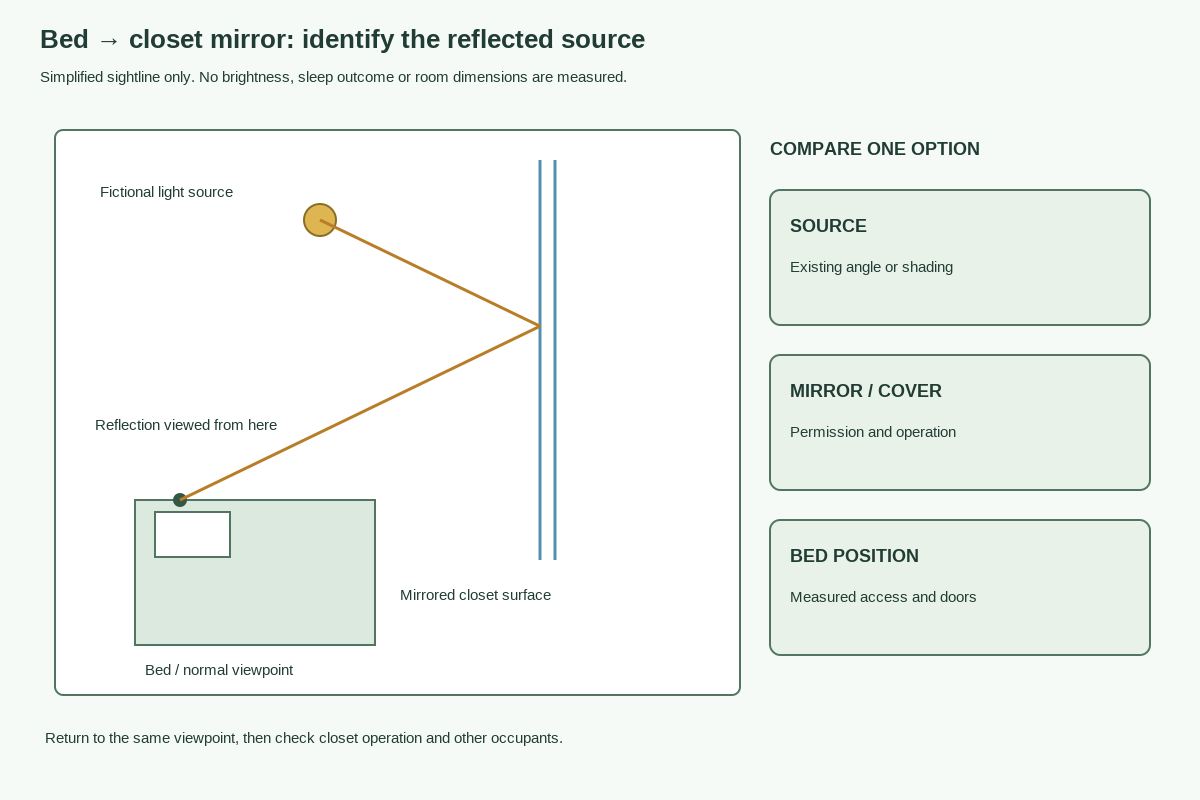
Record the difficulty in your own words. “The lamp appears in the mirror from my pillow” gives you something to compare. “A bed reflection proves bad luck” does not follow from this worksheet. The diagram is an original schematic, not a measurement of your bedroom or a report of improved sleep.
Trace the source, mirror and viewpoint separately
Keep three things on your sketch: your normal viewpoint, the mirror surface and the object or source reflected. Include which closet panel is visible. A sliding panel may change the visible reflection in different positions; its ordinary operation still needs to work.
| What appears from the bed | Question it raises | First comparison |
|---|---|---|
| Lamp or bright window | Which source is visible and at what time? | Existing source angle or shading, then the same viewpoint. |
| Passing person or doorway movement | Is entry or movement bothering the occupant? | Actual household route and an agreed entry routine. |
| Bed or self with no bright source | Does the occupant prefer less reflection? | A feasible preference-based option without inventing a health claim. |
| Different reflection with panel moved | Does normal closet operation change the sightline? | Check open/closed positions and actual storage access. |
| Loose or damaged mirror/fitting | Is there a maintenance issue? | Stop the decor trial and use the landlord or appropriate repair process. |
The ray in the illustration simply connects a fictional source, mirror point and viewpoint. It helps explain why changing a source or viewpoint can change what appears in a mirror. It does not calculate brightness, survey the surface or guarantee that a proposed angle will remove your reflection.
Look in the normal position and at the relevant time. A reflection seen while standing at the bedroom door may differ from one seen lying down. There is no need to photograph a sleeping person or share private room images; a short sketch and written observation can be sufficient.
Try an existing light control before adding a cover
If the issue is a reflected lamp or window, first compare a permitted adjustment to the source. Use an existing blind or a feasible task-lamp angle, keeping the lamp stable and within its instructions. Then return to the same normal viewpoint and see whether the unwanted reflection changes.
Check the task the light was serving. Removing a reflection by making a notebook unreadable is not a complete solution for an active reader. CCOHS distinguishes general and task light and notes that daylight varies with the building and conditions. Repeat the task and record which conditions were actually observed.
For a screen or desk next to a window, use the separate desk/window comparison. For broader daylight and evening-light questions, use the dark-room lighting guide. This mirror page concerns the specific bed-to-mirror sightline, rather than a general lighting survey.
Do not cover an operating lamp, obstruct equipment ventilation or alter wiring to remove a reflection. A fixed light or damaged mirror that needs repair is a maintenance question for the appropriate process, not an improvised feng shui project.
Compare cover, angle and bed changes without skipping operation
If a preference remains after the source check, compare only options the occupant wants and is permitted to try. A proposed cover must be suitable for the surface, attachment and closet operation. “Removable” on a product label does not establish landlord permission or compatibility with a particular mirror or finish.
| Candidate | What must be checked first | Reason to reject or leave open |
|---|---|---|
| Keep mirror and use existing shading/source angle | Task light, normal viewpoint and needed controls | Source control leaves another task unusable or is not permitted. |
| Use an approved, suitable removable cover | Owner/manufacturer compatibility, secure appropriate attachment and panel travel | Attachment, surface compatibility or sliding/hinged operation is unresolved. |
| Change a movable mirror’s angle | Permission, fittings, stability and effect from actual viewpoint | Mirror is fitted, movement is unsafe or a new reflection/route conflict appears. |
| Compare another bed position on paper | Full bed frame, room/closet doors, window and occupant access | A new footprint or operation conflict is found. |
| Keep the current arrangement | Whether a practical difficulty actually exists | No change is required merely because a reflection is visible. |
Do not hang a blanket or loose material where it can catch the closet mechanism, interfere with a fitting or create another obstruction. Do not detach a fitted mirror or improvise its support. If a cover’s installation or operation is uncertain, leave that option open and ask the appropriate owner or supplier rather than testing it on a fragile surface.
If moving the bed is genuinely an option, use the measured footprint and door-swing guide first. Removing a mirror sightline while preventing closet use, a door opening or the occupant’s bed access is not a useful replacement layout.
For a shared bedroom, obtain the other person’s agreement and check their viewpoint. A change that hides one person’s reflection can direct a bright source toward the other position. Keep both answers visible in the record.
Keep a mirror preference separate from a sleep claim
A reader may prefer less reflection around the bed as part of their feng shui practice. That preference can be recorded without claiming that every mirror facing a bed is harmful, that the reflection predicts relationship problems, or that covering it guarantees better sleep.
In Tori McBrien’s checked International Feng Shui Guild article, mirrors are mentioned as a possible way to expand awareness when a command position is constrained. Her biography identifies Black Sect practice. That is a different stated use, and it is not a universal requirement to add or remove a bedroom mirror.
NHLBI recommends a quiet, cool and dark bedroom, with a dim night light if needed. It also discusses limiting light and sound distractions for daytime sleep. This supports keeping unwanted light separate from furniture symbolism; it does not evaluate a mirror-cover treatment or a compass direction.
If there is a persistent sleep or other health concern, keep it separate from this layout trial and use appropriate professional advice. The outcome recorded here is a changed sightline or an occupant’s stated preference, not a clinical improvement.
Review from the same viewpoint and retain the narrow result
Try one permitted, feasible change and compare the same viewpoint and task. Note the source, daylight or electrical-light condition, mirror-panel position and any other occupant’s use. If conditions changed at the same time, write that down.
A useful record might say “the lamp was no longer visible in this panel from this pillow position after the permitted angle change,” if that is actually observed. It should not claim that the mirror’s effect on energy, health or sleep has been measured.
Check normal closet use, the room door, window access and the actual route after any physical change. USFA says to map doors and windows and keep them unblocked. Keep the current arrangement when there is no practical difficulty or when the proposed change creates a worse one. Leave maintenance, permission or fitting questions for the appropriate process.
Keep a room record
Download the plain-text room record, or copy the prompts below into your own notes. Use your actual observations and leave unchecked conditions visible. The file is blank and contains no measurements from your home.
BED-TO-MIRROR SIGHTLINE RECORD

Date / person / normal pillow or seated viewpoint:

Mirror panel and ordinary open/closed position:

What is reflected: source / movement / bed or self:

Actual source and daylight/electrical-light conditions:

Observed difficulty or stated preference:

Existing permitted source control tried:

Cover / angle / bed option and unresolved permission or fitting:

Same-viewpoint observation afterward:

Other occupant’s view and agreement:

Closet / room door / window / bed route checked:

Keep / reverse / maintenance or other question:
Try these room checks
For each fictional case, decide what is observed and what still needs checking, then expand the explanation.
Case 1: A lamp appears in the mirror from the pillow. Must the bed be moved first?
No. Compare the reflected source and an existing permitted control first.
A light-source question can differ from a bed-position preference. Check the same viewpoint and keep the active task usable.
Case 2: The bed is reflected but no bright source bothers the occupant. Does that prove harm?
No. A visible reflection does not establish a health or relationship outcome.
The occupant can state a preference without inventing a causal finding or an automatic need to buy a cover.
Case 3: A removable cover product is available. Are permission and closet operation therefore settled?
No. Check the specific surface, attachment, owner requirements and panel operation.
A product label cannot approve a rental alteration or establish compatibility with an actual fitting.
Case 4: A change removes one person’s lamp reflection. Is the shared-room check complete?
No. Check the other occupant and normal room/closet use too.
The reflection may change elsewhere, and a new physical obstruction can outweigh the chosen sightline improvement.
Sources and scope
- CCOHS: Lighting Ergonomics — General — General and task light, glare and changing daylight. Workplace guidance; no bedroom illumination standard is inferred.
- Tori McBrien / International Feng Shui Guild: The Feng Shui Command Position — A named practitioner convention: see the entrance without direct alignment. Her biography names Black Sect practice; no clinical or career effect is established.
- NHLBI: Healthy Sleep Habits — Quiet, cool, dark bedroom, quiet time before bed and removal of distractions for daytime sleep. Furniture directions and feng shui remedies are not evaluated.
- USFA: Home Fire Escape Plans — Map actual doors and windows and keep them unblocked. Follow the actual building and local arrangements; no universal route width is supplied.